Offsetting penalties and double fouls explained: replayed downs, 15 against 5 and the clean-hands rule
When both teams are flagged, the down is usually replayed, but not always. Here is how the NFL handles double fouls, the 15-against-5 exception, fouls after the play, clean hands on turnovers and the untimed down.
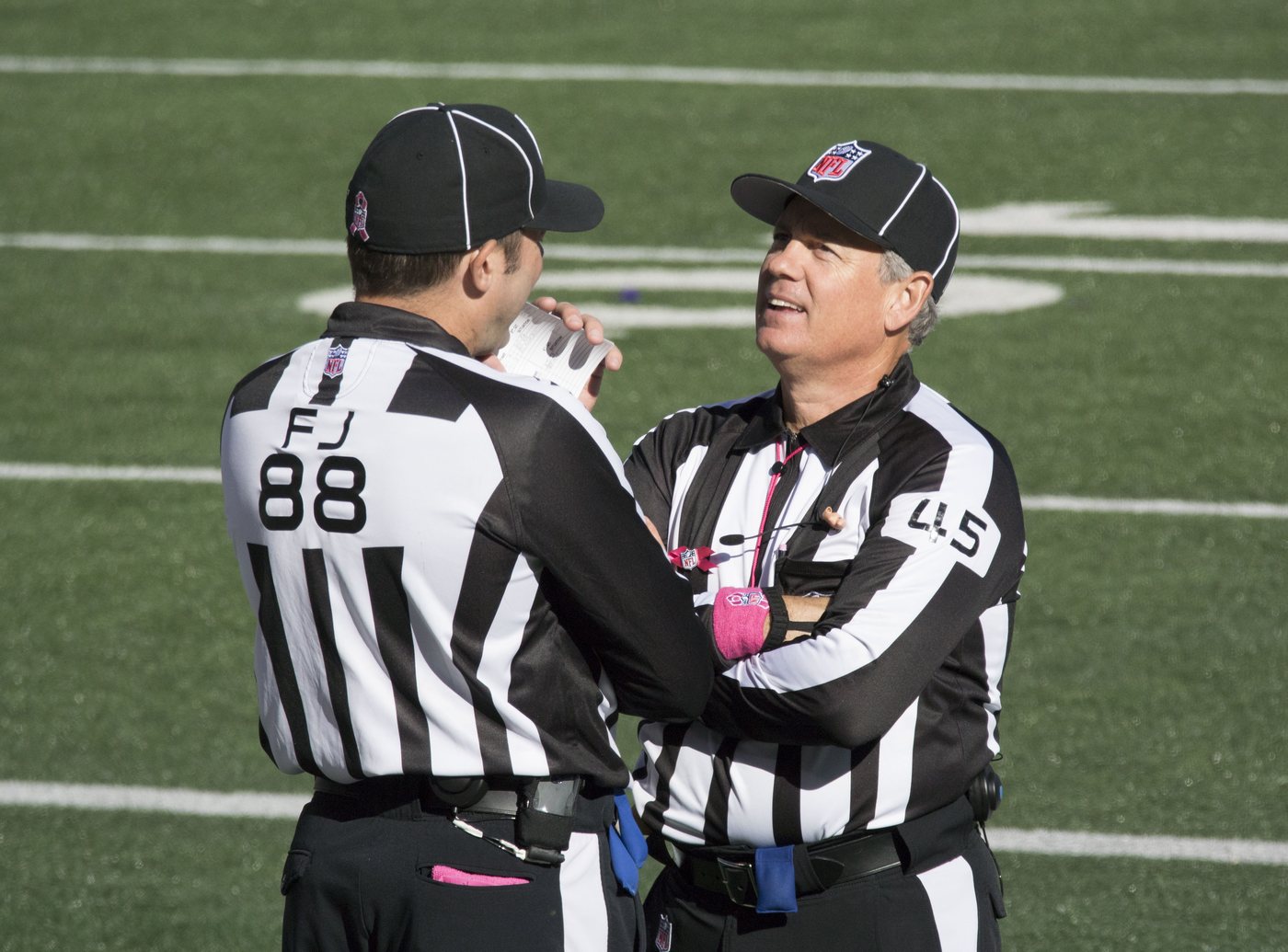
When both teams are flagged on the same play, the referee often announces that the penalties offset and the down will be replayed. That is the usual result, but not always. A big personal foul can beat a small one, an interception can stand or be wiped out depending on when the fouls happened, and a double foul at the end of a half can add an extra play. Here is how the NFL rulebook handles fouls by both teams.
What counts as a double foul
Rule 3 defines a double foul as a down in which both teams commit at least one foul, including fouls after the ball is dead. Two or more fouls by the same team on one play are a multiple foul, and in that case the other team chooses which one penalty to take.
A violation, such as an illegal touch of a punt, is not a foul and never offsets a foul. A foul between downs, after the play and any action that follows it, is always enforced on its own and cannot be combined with fouls from the play.
The basic rule: replay the down
Rule 14, Section 5 says that if both teams foul during a down with no change of possession, the penalties offset and the down is replayed from the previous spot. The down number and the line to gain stay the same, and neither team can decline the penalties. Any yards gained and any score on the play are wiped out.
Green Bay learned that in Week 2 at the Jets. Trailing 17-7 midway through the fourth quarter, Jordan Love scrambled 7 yards for a touchdown. Packers tackle Anthony Belton was flagged for holding, and Jets linebacker Jamien Sherwood was called for unnecessary roughness. The touchdown came off the board and Green Bay replayed first-and-goal from the 7. It scored two plays later and won 20-17 in overtime.
The exception: 15 yards against 5
The rule has one major exception. If one team’s foul carries a 15-yard penalty and the other team’s foul is a simple 5-yard penalty, the 15-yard penalty is enforced from the previous spot and the 5-yard foul is ignored. The team that committed the 5-yard foul cannot turn that down.
It applies only to a true 5-yard foul. It does not apply if the smaller foul also carries an automatic first down, a loss of down or a 10-second runoff. Holding is 10 yards, so holding against a 15-yard foul still offsets.
That happened in Dallas’s Week 6 game at Green Bay. With 10 seconds left in the third quarter, a Cowboys offensive lineman was flagged for holding and a Packers linebacker for taunting. Taunting is a 15-yard foul, but holding is not a 5-yard foul, so the penalties offset. Dallas replayed third-and-6 from its 35.
| Fouls on the play | Result |
|---|---|
| Both teams commit live-ball fouls, no change of possession | Penalties offset, down replayed from the previous spot |
| 15-yard foul by one team, simple 5-yard foul by the other | 15-yard penalty enforced from the previous spot, 5-yard foul ignored |
| 15-yard foul against a 10-yard foul, such as holding | Penalties offset, down replayed |
| Both fouls come after the play is over | Penalties offset, the play counts and the ball goes to the succeeding spot |
| Change of possession, and the team that gains the ball did not foul before getting it | That team keeps the ball, and its own foul is enforced |
| Change of possession, but the team that gains the ball fouled before getting it | Penalties offset, down replayed |
Fouls after the play
When both teams foul after the down is over, the play itself stands. The fouls offset at the succeeding spot, and the down counts. Any player who is disqualified must still leave the game.
Indianapolis benefited from that in Week 2 at Kansas City. On third-and-6 just before halftime, Daniel Jones threw a 7-yard pass to Josh Downs, who was pushed out of bounds at the Kansas City 24. Downs and Chiefs cornerback L’Jarius Sneed were both flagged for unnecessary roughness after the play. Because both fouls came after the play, the catch counted and the Colts kept their first down. Jonathan Taylor ran 24 yards for a touchdown on the next snap.
Ejections do not offset in the same sense. The opening kickoff in London in Week 5 is the clearest example this season. Jacksonville’s Josh Cameron returned it 90 yards for a touchdown, but the Eagles were flagged for an illegal formation and the Jaguars for holding. Then Philadelphia’s Jeremiah Trotter Jr. and Jacksonville’s Bryan Thomas Jr. were ejected after a fight. The penalties offset and the touchdown was erased. Both players still had to leave, and Philadelphia kicked off again.
Interceptions, fumbles and “clean hands”
A change of possession brings in the idea of clean hands. If both teams foul on a play where the ball changes hands, the team that ends up with the ball keeps it, but only if it did not foul before it gained possession. Its own foul is then enforced. If its hands are not clean because it fouled first, the penalties offset and the down is replayed.
New Orleans lost an interception that way in Week 6 at the Giants. With the Saints ahead 17-10 in the third quarter, Quincy Riley intercepted Jameis Winston on third-and-8 and returned it to the New York 39. But Cameron Jordan had been offside on the snap, before the interception, and a Giants lineman was flagged for holding. Because the Saints fouled before they gained the ball, the penalties offset and the Giants replayed third-and-8 from their 16. New York was then called for two false starts and eventually punted. The Saints won 34-27.
When both teams foul after the change of possession, such as two personal fouls during an interception return, the penalties offset and the team with the ball keeps it at the spot where its own foul would have been enforced. Special rules apply on kicks. If the kicking team fouls before the receiving team gets the ball, the receiving team can choose to replay the kick.
Double fouls at the end of a half
Normally, a half cannot end on a play with offsetting penalties. If there is a double foul on the last play of the second or fourth quarter, the period is extended with an untimed down. There are four exceptions in Rule 4:
- Both fouls come after the play is over.
- It is a 15-yards-against-5 foul, and the 15-yard foul is by the offense or comes after the play.
- The defense’s only foul comes after the play. Unless the offense’s foul is also a personal or unsportsmanlike conduct foul, it is ignored, and the defense’s foul is enforced on the second-half kickoff or the kickoff to start overtime.
- There is a change of possession and the team that gained the ball had clean hands, so the down is not replayed.
There is no extra play at the end of the first or third quarter. The teams simply change ends.
How often it happens
Offsetting penalties are not common. The official play-by-play has fewer than one play with offsetting penalties for every three games each season since 2018.
| Season | Regular-season games | Plays with offsetting penalties | Per game |
|---|---|---|---|
| 2018 | 256 | 71 | 0.28 |
| 2019 | 256 | 66 | 0.26 |
| 2020 | 256 | 47 | 0.18 |
| 2021 | 272 | 60 | 0.22 |
| 2022 | 271 | 52 | 0.19 |
| 2023 | 272 | 58 | 0.21 |
| 2024 | 272 | 84 | 0.31 |
| 2025 | 272 | 69 | 0.25 |
| 2026, through Week 7 Thursday | 94 | 19 | 0.20 |
The most common pairing in 2026 is offensive holding against a defensive foul. San Francisco’s Week 2 punt against Miami is one example. The 49ers’ long snapper was called for holding, and a Dolphins player was flagged for running into the kicker. Running into the kicker is a 5-yard foul, but holding is 10, so the punt was replayed.
What to watch for
- Count the yards. A 15-yard foul against a 5-yard foul is not an offset. A 15-yard foul against a 10-yard foul is.
- Listen for when the foul happened. Fouls after the whistle by both teams leave the play and its yards in place.
- Watch turnovers. An interception or fumble recovery stands only if the team that got the ball did not foul first.
- Check the clock at the end of a half. Offsetting fouls on the last play usually mean one more untimed down.
- Ejections still count. Offsetting fouls do not bring a disqualified player back.
Related WhyNFL reading: After the flag: how to read a penalty, Holding, Unsportsmanlike conduct and taunting, Offside and false start and the London kickoff ejections.
A rule or explanation needs a second look? Tell us through our corrections process.