False start, encroachment, neutral zone infraction and offside explained: the NFL’s four 5-yard jump fouls
False start, encroachment, neutral zone infraction and offside all cost five yards, but they are different fouls. Here is how the 2026 Official Playing Rules separate them — who moved, whether there was contact, whether the play is killed — and why false starts are up in 2026.
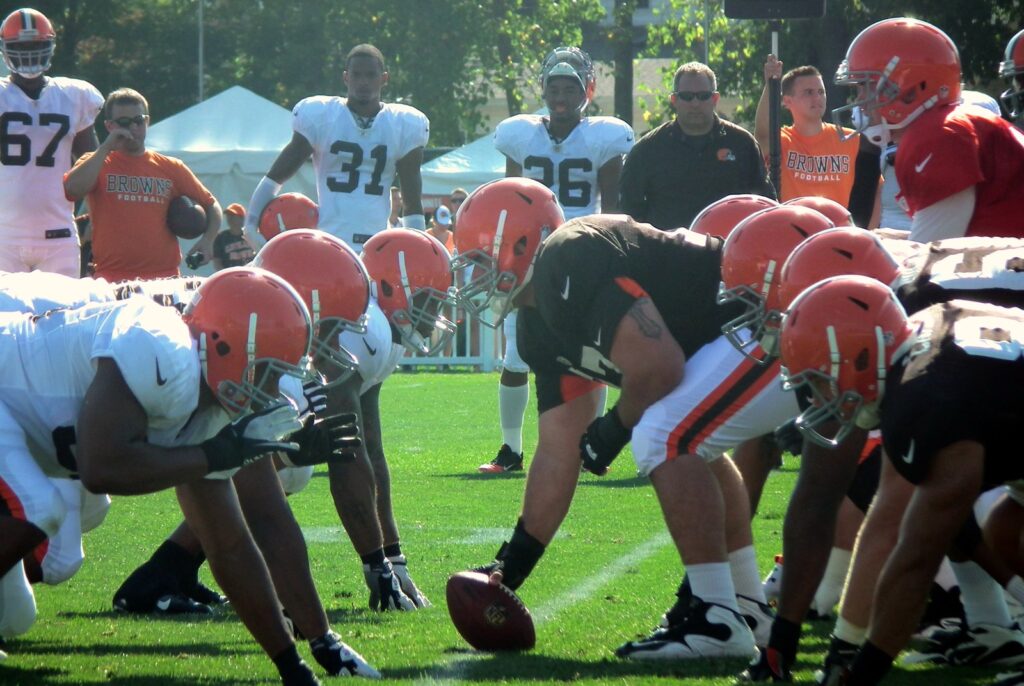
Four different flags can stop a snap — or follow it — for the same five yards: false start, encroachment, neutral zone infraction and offside. They are announced with similar words and often happen within a split second of each other, but they are not interchangeable. Which one the officials call decides whether the play is killed, whether anyone gets a first down, and which team pays.
All four live in Rule 7, Section 4 of the 2026 Official Playing Rules. This guide explains each one, how officials tell them apart, and why false starts have become one of the defining flags of the 2026 season.
Start with the neutral zone
The neutral zone is the space between the front and back points of the football, extending to both sidelines (3-18-2). It exists as soon as the ball is made ready for play. From that moment, under 7-4-1:
- an offensive player may not make a false start;
- a defensive player may not encroach or commit a neutral zone infraction;
- no player on either team may be offside when the ball is snapped.
Offensive linemen may not have any part of their bodies in the neutral zone at the snap; the snapper may not be beyond it. A defender is considered on the line if he is within one yard of it.
False start: the offense flinches (7-4-2)
A false start happens when, after the ball is ready, an offensive player who is set moves in a way that simulates the start of a play, or a player already in motion makes a sudden move toward the line. Officials blow the whistle immediately, whether or not the ball is snapped and whether or not the defense reacts. The rule then gets specific:
- Interior linemen (tackle to tackle) who take or simulate a three-point stance may not change position or move the hand on the ground. A lineman in a two-point stance may reset into a three-point stance, but he must come to a complete stop.
- Eligible receivers on the line: once everyone has been set for a full second, any forward movement is a false start — quick or slow. Moving backward or changing stance without stopping again is also a false start.
- Backfield players may change stance without stopping, as long as the move is not abrupt (false start) or forward (illegal motion).
- Under-center quarterbacks may go in motion, but a quick, abrupt move is a false start.
- Shotgun quarterbacks may shift their feet, but a quick, abrupt movement — including thrusting the hands forward without a snap — is a false start.
- Drawing the defense offside: varying the cadence is part of the game, but an obvious attempt by the passer or the player receiving the snap to draw an opponent offside is itself a false start.
Penalty: five yards from the line of scrimmage, enforced before the snap. The down is replayed, so third-and-2 becomes third-and-7.
One late-game wrinkle: after the two-minute warning of either half, with the game clock running, an offense that is not fully set for one second before the snap is charged with a false start instead of an illegal shift (7-4-2 Item 6). Because the foul stops the clock while the ball is dead, the offense also faces a 10-second runoff (4-7-1), which it can avoid with a timeout. Our game clock and play clock guide explains the runoff in detail.
Encroachment: the defense makes contact (7-4-3)
Encroachment is the defensive cousin of a false start. A defender commits it when he enters the neutral zone and contacts an offensive player or the ball before the snap, or interferes with the ball during the snap. The whistle blows immediately and the defense loses five yards.
The key word is contact. A defensive end who leans into the neutral zone and gets back without touching anyone has not encroached.
Neutral zone infraction: no contact needed (7-4-4)
A neutral zone infraction covers the moments when a defender jumps but does not touch anyone. Officials kill the play and penalize the defense five yards when:
- a defender moves beyond the neutral zone before the snap and is parallel to or past an offensive lineman with an unimpeded path to the quarterback or kicker;
- a defender enters the neutral zone and causes an offensive player in close proximity to react immediately to protect himself. If nobody nearby reacts and the defender gets back before the snap without contact, there is no foul;
- in the last two minutes of a half, the ball is snapped while a defender is still on the wrong side of the line — provided the offense is legally set.
“Close proximity” is defined: a flexed or split receiver counts if he is lined up on the side of the ball where the defender jumped; other offensive players count if they are within two and a half positions of the defender. If the defender is directly over the center, the center, both guards, both tackles and an under-center quarterback all count.
This is why a lineman who flinches because a defender lunged at him is not charged with a false start. The defender caused the reaction, so the foul is on the defense.
Offside: caught at the snap (7-4-5)
A player is offside when any part of his body is in or beyond the neutral zone when the ball is snapped. Unlike the three fouls above, offside does not kill the play. The official throws a flag, the snap goes ahead, and the offense knows it can take the result of the play or the five yards. That is why quarterbacks often throw deep when they see a defender jump early.
Penalty: five yards. Defensive offside, encroachment and neutral zone infractions do not carry an automatic first down; they produce one only if the five yards reach the line to gain (14-1-2 lists all three as exceptions to the first-down rule for defensive fouls).
The four fouls side by side
| Foul | Rule | Team | Contact needed? | Play killed? | Penalty |
|---|---|---|---|---|---|
| False start | 7-4-2 | Offense | No | Yes, whistle immediately | 5 yards, replay the down |
| Encroachment | 7-4-3 | Defense | Yes — player or ball | Yes, whistle immediately | 5 yards, no automatic first down |
| Neutral zone infraction | 7-4-4 | Defense | No | Yes, whistle immediately | 5 yards, no automatic first down |
| Offside | 7-4-5 | Either team | No | No — the play runs | 5 yards, no automatic first down |
When the defense tries to cause a false start
Defenses cannot bait the offense with fake movements of their own. A defender set within one yard of the line who makes quick, abrupt actions that are not normal defensive movement, in an obvious attempt to make an offensive player flinch, is flagged for delay of game (4-6-5-d) — five yards. A defender who is walking or running toward the line to time the snap and stops abruptly because the ball was not snapped has not fouled.
Calling out fake signals is worse. Acts or words by the defense designed to disconcert the offense at the snap are unsportsmanlike conduct (12-3-1-i): 15 yards and an automatic first down.
Why false starts matter in 2026
The flag surge of 2026 has been an offensive problem, and false starts are part of it. Through Week 5, penalty trackers counted 222 accepted false starts — 2.81 per game — compared with 191 at the same point of 2025 and 204 in 2024. Cleveland had a league-high 25 accepted fouls before the snap. League figures through Week 4 also showed dead-ball fouls, the category that includes false starts, encroachment and neutral zone infractions, rising from 6.44 to 6.69 per game.
Those flags hurt in specific places: a false start on third-and-short turns a sneak into a long passing down, and in the red zone it can push a team from touchdown range to a field-goal try. For the full numbers, read NFL penalties after Week 5: The 2026 flag surge.
What to watch on the next flag
- Was the whistle before the snap? Then it is a false start, encroachment or a neutral zone infraction. If the play ran, look for offside.
- Who moved first? If an offensive lineman flinched, it is a false start. If a defender lunged and the lineman reacted, it is on the defense.
- Was there contact? Contact makes it encroachment. A free run at the quarterback or a reaction without contact makes it a neutral zone infraction.
- Check the down. A false start repeats the down with more yards to go. A defensive jump gives five yards but not an automatic first down.
- Late in a half? An offensive false start with the clock running after the two-minute warning can also bring a 10-second runoff.
Related WhyNFL reading: Illegal formation, shift and motion explained, After the flag: how to read a penalty, Two clocks, one possession, Downs, distance and scoring.
A rule or explanation needs a second look? Tell us through our corrections process.