Holding and illegal contact explained: the NFL’s most-called foul and its 5-yard cousins
Offensive holding, defensive holding and the five-yard illegal contact rule under the 2026 Official Playing Rules: what counts, when holds are not called, where the yards are marked off, why a hold in the end zone is a safety, and how the rules got here.
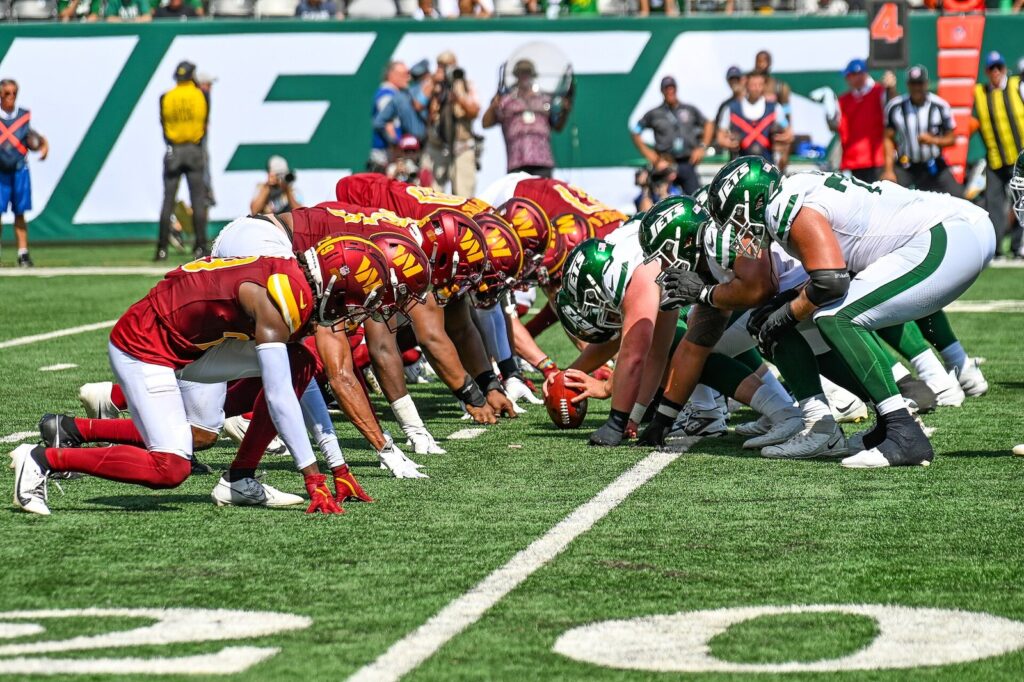
No foul is thrown more often in the NFL than offensive holding. Through Week 5 of the 2026 season (79 games), officials had accepted 260 offensive holding penalties — about 3.3 a game — and 41 more were declined or offset, according to public penalty-tracker data. Tampa Bay had been flagged for the most, 13. Defensive holding (62 accepted) and illegal contact (23) are called far less often, but both come with an automatic first down.
All three live in the 2026 Official Playing Rules, mainly Rule 12, Section 1 (blocking and use of hands) and Rule 8, Section 4 (contact with eligible receivers). Here is how each one works.
What a blocker is allowed to do
Holding only makes sense against what is legal. Under 12-1-2, an offensive blocker may use his arms and open or closed hands on an opponent’s frame — the body below the neck that is presented to him — or even outside it, provided he does not materially restrict the defender. He must work immediately to get his hands inside the frame, and he may then work for and keep his position.
Offensive holding (12-1-3-c)
It is offensive holding when a blocker uses his hands or arms to materially restrict or alter the defender’s path or angle of pursuit. The rule says plainly that it is a foul regardless of whether the hands are inside or outside the frame. Material restrictions include, but are not limited to:
- grabbing or tackling an opponent;
- hooking, jerking, twisting or turning him;
- pulling him to the ground.
Penalty: 10 yards. The signal is a grasping motion of one wrist, and the broadcast abbreviation is usually OH.
When offensive holding will not be called
The rulebook lists specific situations where a hold is not flagged. The ones fans see most:
- The runner is being tackled at the same moment, or simultaneously goes out of bounds.
- The action clearly happens after a forward pass has been thrown to a receiver beyond the line.
- It is away from the point of attack and not in close-line play.
- It is part of a double-team — unless the defender splits the double team, gets outside either blocker, or is taken to the ground.
- The defender uses a rip move that puts the blocker in what looks like a holding position — unless and until the blocker takes the defender’s feet away.
- A blocker falls on or pushes down a defender whose momentum was already carrying him down — unless the blocker then keeps him from getting up.
- A free kick or scrimmage kick simultaneously becomes a touchback, or a fair catch is made at the same time.
Where the 10 yards are marked off
This is why the same foul can cost a different amount on different plays.
- Pass play: any foul from the snap until a pass thrown from behind the line ends is enforced from the previous spot (8-6-1). Ten yards back from the line of scrimmage, replay the down.
- Run play: the three-and-one method applies (14-3-6). A hold behind the line of scrimmage is enforced from the previous spot. A hold beyond the line but behind where the run ended is enforced from the spot of the foul — so a 20-yard run with a hold 5 yards downfield comes back to 5 yards past the line, then 10 more.
- In the offense’s own end zone: if the defense accepts the penalty at the spot, it is a safety (14-2-2 and 14-3-6). That is how a tackle grabbing an edge rusher at the goal line gives away two points.
- Near the goal line: no distance penalty can be more than half the distance to the offender’s goal.
Defensive holding (12-1-6 and 8-4-6)
It is defensive holding when a defender tackles or holds any opponent other than the runner, except where the rules allow defenders to push, pull or ward off blockers (12-1-5). On pass plays, 8-4-6 spells it out: grasping an eligible receiver or his jersey with the hands, or extending an arm or arms to cut off or encircle him. A player who fakes having the ball — or who receives a fake handoff — may be tackled as a runner until he leaves the pocket area.
There is also a kicking-game version: on a punt, field goal or extra-point kick, one defender grabbing and pulling a blocker out of the way so a teammate can shoot the gap (the pull-and-shoot) is defensive holding, unless the grabbing player is himself advancing toward the kicker.
Penalty: 5 yards and an automatic first down. The yardage is small — the 62 accepted defensive holds through Week 5 of 2026 cost a combined 282 yards, under five apiece, because half-the-distance enforcement near the goal line trims some of them — but the automatic first down is what hurts on third-and-long.
Illegal contact: the five-yard rule (8-4)
Illegal contact is the receiver-only foul, and it only exists while the passer is still a passer. The rules apply when the player who received the snap remains in the pocket area with the ball.
- Within five yards of the line of scrimmage, a defender may chuck a receiver who is in front of him and keep continuous contact — but only until the receiver gets even with him. He may not make initial contact in the receiver’s back, and if he loses contact he may not re-establish it inside the zone.
- Beyond five yards, a defender may not initiate contact with a receiver who is trying to evade him. He may use his hands only to protect himself from contact the receiver causes. A defender who has been riding a receiver must release him as they leave the five-yard zone. Incidental contact is allowed.
Penalty: 5 yards and an automatic first down.
The restrictions end as soon as the quarterback shows no further intention to pass — a handoff, pitch, forward or backward pass, fumble or sack. If the quarterback leaves the pocket with the ball, illegal contact no longer applies, but defensive holding still does. And when the offense shows a punt formation, chucking receivers beyond five yards is permitted, as long as it is not a hold.
Holding or pass interference?
Pass interference requires an act more than one yard beyond the line of scrimmage that significantly hinders a receiver’s chance to catch the ball; defensive pass interference is only possible once the pass is thrown. Grabbing a receiver before the throw, or within a yard of the line, is not interference — the rule says it could be offensive or defensive holding instead (8-5-1). That is why a corner grabbing a jersey at the top of the route before the ball is out draws a 5-yard hold rather than a spot foul.
| Foul | Rule | Penalty | 2026 accepted, Weeks 1-5 |
|---|---|---|---|
| Offensive holding | 12-1-3(c) | 10 yards (safety if enforced in own end zone) | 260 |
| Defensive holding | 12-1-6, 8-4-6 | 5 yards, automatic first down | 62 |
| Illegal contact | 8-4-2, 8-4-3 | 5 yards, automatic first down | 23 |
| Defensive pass interference | 8-5 | Spot of foul, first down | — |
One kicking-play wrinkle: on a scrimmage kick that goes beyond the line of scrimmage, holding and illegal use of hands by either team cost 10 yards, unless the foul was committed in an attempt to block the kick. That is why a hold by the punt return team costs as much as an offensive hold.
How the five-yard rule got here
Before 1978, cornerbacks could hit receivers all the way down the field. That year the league limited contact to the first five yards — a change widely nicknamed the Mel Blount Rule, after the Steelers’ Hall of Fame cornerback who manhandled receivers at will. Passing numbers rose in the seasons that followed.
The rule has been re-emphasized whenever officials drift. After the 2003 AFC Championship Game, in which New England’s defensive backs repeatedly disrupted Indianapolis receivers and Ty Law intercepted Peyton Manning three times, the competition committee — Colts president Bill Polian was a member — made illegal contact a point of emphasis for 2004. No rule changed; officials were told to call it as written. Manning threw 49 touchdown passes that season. The league leaned on illegal contact and defensive holding again in 2014.
What to watch on the next flag
- Did the defender’s path change? Hands outside the frame are not a foul by themselves; turning, hooking or dragging the defender is.
- Was it at the point of attack? Backside grabs away from the play are often left alone.
- Where was the quarterback? Once he leaves the pocket or throws, illegal contact is off the table — but a defensive hold is still a hold.
- Where did the run end? On a long run, a hold downfield costs the yards gained after the foul plus 10.
- Was it in the end zone? An accepted offensive hold there is a safety.
Related WhyNFL reading: The Colts’ fake punt that was never supposed to be snapped, Pass interference explained, Formations and eligible receivers, How to read a penalty.
A rule or explanation needs a second look? Tell us through our corrections process.