Palpably unfair act explained: when the NFL referee can award a score
Rule 12-3-4 lets the referee choose any fair penalty, disqualify the offender or award a touchdown that never happened. Here is how it works in 2026, the 1954 Cotton Bowl play behind it, the Tomlin and NFC Championship near misses, and how Rule 17 goes further.
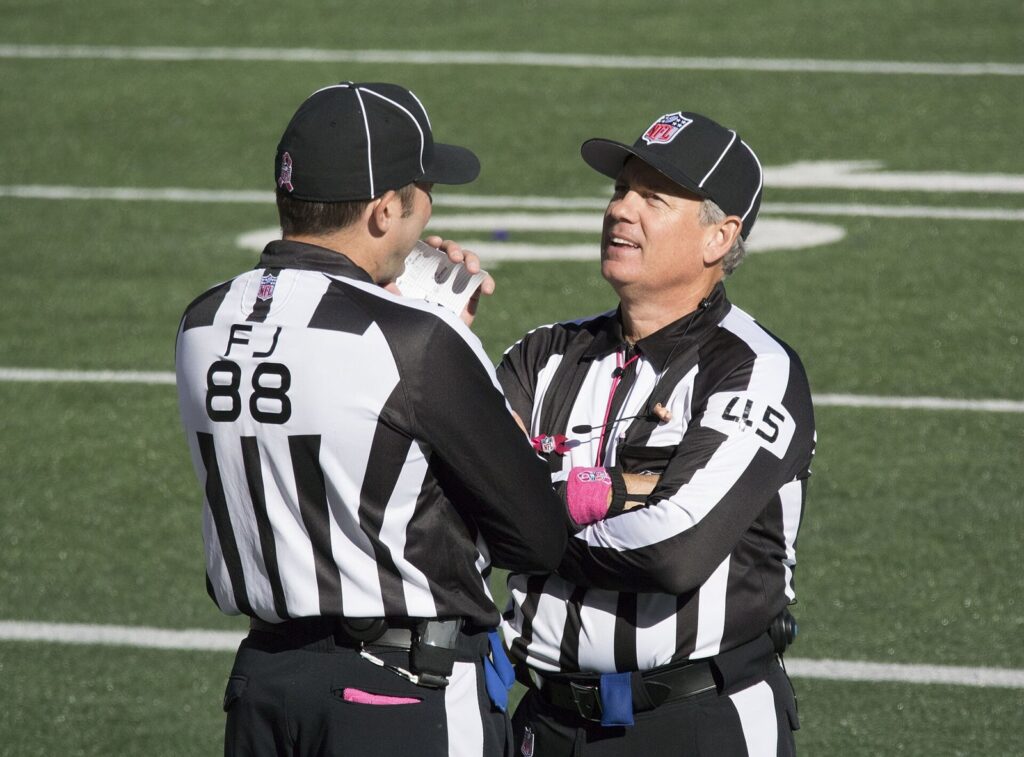
Most NFL fouls come with a fixed price: 5, 10 or 15 yards, sometimes a first down. One does not. Rule 12, Section 3, Article 4 bans a palpably unfair act, meaning something so plainly unfair that the normal penalty would not fix it. When that happens, the referee does not look up a yardage. After talking with the crew, the referee chooses whatever remedy is fair, and that can include awarding a score that never happened.
It is the rulebook’s emergency clause. Through Week 5 of 2026 (79 games), public play-by-play logs show no palpably unfair act calls, and no NFL referee is known to have awarded a touchdown under it. The rule matters because officials can use it, and because teams have gotten close enough for referees to warn them.
What the 2026 rule says
Rule 12-3-4 is short: a player or substitute “shall not interfere with play by any act which is palpably unfair.” The penalty paragraph gives the referee three powers:
- the offender may be disqualified;
- the referee, after consulting the officiating crew, enforces any distance penalty the crew considers equitable, “irrespective of any other specified code penalty”;
- the referee may award a score (cross-referenced to Rule 19, where the referee is the final authority on the score).
Rule 11-2-1(e) spells out the touchdown version: the referee awards a touchdown to a team that was denied one by a palpably unfair act. Rule 12-3-1(s) gives the same power on kicks. If a defender jumps up to goaltend a field goal over the crossbar, the referee may award the three points.
Coaches, staff and anyone off the bench
The rule also covers people who are not in the game. Rule 13-1-7 says a non-player “shall not commit any act which is palpably unfair,” and the referee again makes whatever ruling is equitable. Rule 13-1-8 adds that coaches, trainers, equipment staff and team management may not make unnecessary physical contact with opponents or officials, or use abusive, threatening or insulting language or gestures, and that game-day violations, “including postgame,” can bring discipline from the Commissioner.
Substitutes are covered too. Under Rule 5, a substitute who runs onto the field during a live ball is a 5-yard illegal substitution. If that substitute interferes with the play, Rule 5-2-8(c) sends it to 12-3-4 instead. That is how a 5-yard foul can become an awarded touchdown. Our illegal substitution guide covers the 5-yard version.
The play behind the rule: 1954
The best-known example happened in college. In the 1954 Cotton Bowl, Rice’s Dicky Maegle (often spelled Moegle at the time) broke loose down the sideline on a 95-yard run. Alabama’s Tommy Lewis came off the bench without his helmet and tackled him. The usual penalty for illegal participation was 5 yards. The officials awarded Rice the touchdown.
The NFL rule gives its referees the same power in plain words, and its version has been in the book since at least the 1940s. College officials used that power in 1954. As far as anyone knows, no NFL referee has ever used it to award a score.
Near misses in the NFL
Thanksgiving 2013, Steelers at Ravens. In the third quarter, Baltimore’s Jacoby Jones broke a kickoff return down the Pittsburgh sideline. Steelers coach Mike Tomlin was standing on the white border with his back to the play, and Jones had to swerve around him. No flag was thrown, and Jones was tackled after 73 yards. Baltimore settled for a field goal and won 22-20. The league later fined Tomlin $100,000 and said it might take away a 2014 draft pick, then decided in March 2014 not to. If the crew had judged that Tomlin cost Jones a touchdown, 13-1-7 would have let the referee award it.
January 2025 NFC Championship, Commanders at Eagles. Washington jumped offside three straight times on Philadelphia goal-line sneaks, with linebacker Frankie Luvu twice leaping over the line before the snap. Referee Shawn Hochuli warned Washington that the crew would award a score if it happened again. Philadelphia scored on the next snap, so the warning never had to be enforced. That warning came under a related rule, 12-3-2 (fouls to prevent a score). It says that after a warning, repeated defensive fouls to stop a score mean “the score involved is awarded to the offensive team.”
Other cases that were talked about: teams taking deliberate penalties to run time off the clock, and late, touchdown-saving fouls that led to debate over whether officials should simply award the score. For clock games, 2026 also has its own rule. Under Rule 12-3-3, multiple fouls in one down to run off time cost 15 yards, and the game clock is reset to where it was at the snap.
How the enforcement is different
| Normal foul | Palpably unfair act |
|---|---|
| Fixed yardage from the rulebook | Whatever distance the crew decides is equitable |
| Half-the-distance limit applies near the goal line | Rule 14-2-1 lists 12-3-4 as an exception to the half-distance rule |
| Points come only from a scoring play | The referee may award a touchdown, field goal or other score |
| Disqualification only for listed flagrant fouls | The offender may be disqualified |
| Offensive foul on the last play of a half ends the half | The defense may ask for an untimed down (Rule 4-8-2(b)(3)) |
The rule also appears in other places. If a team commits a palpably unfair act during a down in which the opponent scores, Rule 14-2-3 carries the penalty over to the Try or the next kickoff. In overtime, after the first team with the ball has scored and the second team then loses possession, the rule says only fouls that force a replay, fouls that wipe out a score, or palpably unfair acts are enforced.
Bigger than the referee: Rule 17
Some cases go past the referee. Rule 17, Section 2 gives the Commissioner sole authority over “extraordinarily unfair” acts, such as club actions, interference from someone not taking part in the game, or a calamity, that had a major effect on a game’s result. The penalties can include fines, forfeited draft picks, suspensions and, “if appropriate,” reversing a game’s result or rescheduling it, either from the beginning or from the point of the act.
Rule 17 is not a way for teams to protest. Article 2 says clubs cannot use it to challenge a result, and the Commissioner will not act on complaints about officials’ judgment calls or routine mistakes. Bad calls stand. A sideline tackle or an outside interference may not.
What to watch for
- Someone off the bench or sideline touches a live play. If it costs the runner a sure score, the referee may award it.
- A defense keeps fouling at the goal line. Look for a referee’s warning announcement, which is the 12-3-2 step before awarding a score.
- Goaltending on a field goal. The referee may award the three points (12-3-1(s)).
- Repeated fouls to run time off the clock. Rule 12-3-3 resets the clock; the palpably unfair act rule is still available if a team keeps doing it.
- Postgame contact or abuse. That is 13-1-8, handled by the league office after the game rather than with a flag.
Related WhyNFL reading: Unsportsmanlike conduct, taunting and celebrations, Ejections and suspensions for non-football acts, Illegal substitution and 12 men on the field, Leaping and leverage on kicks, After the flag, October 16, 2011: Harbaugh, Schwartz and the handshake.
A rule or explanation needs a second look? Tell us through our corrections process.