Leaping and leverage on kicks explained
When a defender can jump to block a field goal, what Rule 12-3-1(o)–(s) bans as leaping, leverage and goaltending, how the 15-yard penalty is enforced, and the 2026 Leverage flag that turned a Seahawks miss into three points.
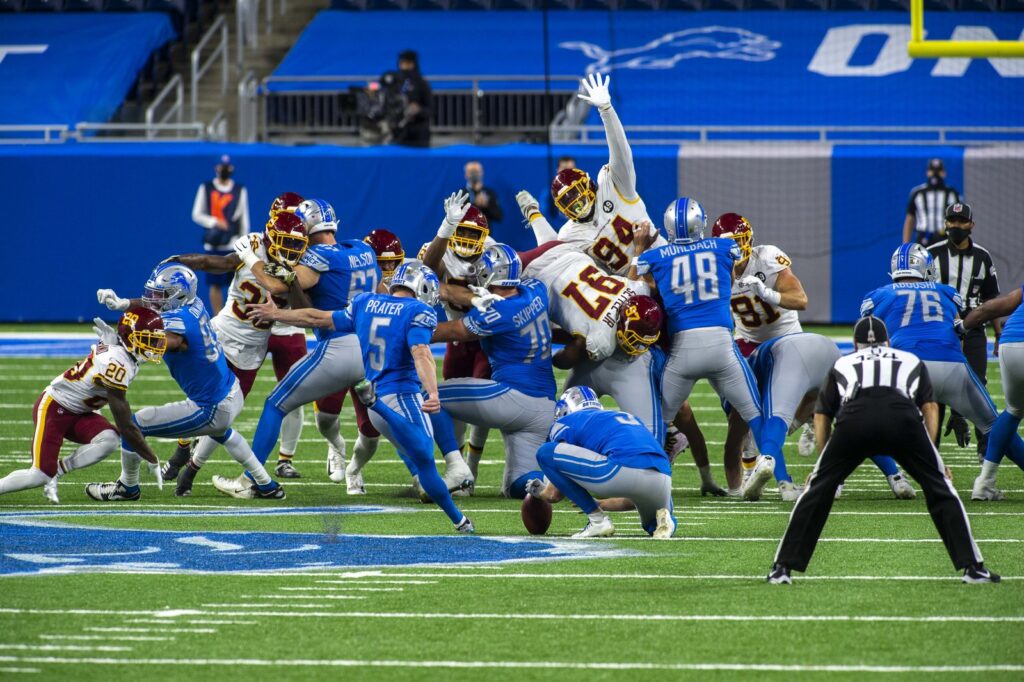
Defenders are allowed to jump to block a kick. What they are not allowed to do is use another body to get higher, get thrown into the air, or take a running start and fly over the line on a field goal or extra point. Those are the leaping and leverage fouls in Rule 12, Section 3, Article 1 of the 2026 Official Playing Rules. Each costs 15 yards and an automatic first down.
On the referee’s foul list they show up as LEA (leaping) and LEV (leverage). They are rare — through Week 5 of 2026, public play-by-play logs show one accepted Leverage foul and no Leaping fouls across 79 games and 698 field-goal and extra-point plays. The one Leverage flag, though, turned a missed 53-yarder into three points.
What Rule 12-3-1 says
The kick-block fouls sit in the unsportsmanlike-conduct article, next to the taunting and celebration rules covered in our unsportsmanlike conduct guide. Four clauses deal with getting airborne; a fifth covers swatting a kick over the crossbar.
| Clause | What is illegal | Applies to | Rulebook name |
|---|---|---|---|
| 12-3-1(o) | Jumping or standing on a teammate or opponent to block or try to block a kick | Any kick or apparent kick | Leaping (LEA) |
| 12-3-1(p) | Placing a hand or hands on a teammate or opponent to gain extra height to block a kick, or to jump through a gap between offensive players | Any kick or apparent kick | Leverage (LEV) |
| 12-3-1(q) | Picking up a teammate to block or try to block a kick | Any kick or apparent kick | Unsportsmanlike conduct |
| 12-3-1(r) | Running forward and leaping across the line of scrimmage in an obvious attempt to block a field goal or Try | Field goals and Try kicks | Leaping (LEA) |
| 12-3-1(s) | Goaltending: leaping to deflect a kick as it passes above the crossbar | Field goals and Try kicks | Goaltending (unsportsmanlike conduct) |
Clause (r) has a built-in exception. A player who was stationary within one yard of the line of scrimmage at the snap may leap. A player lined up more than one yard back may still run forward and jump, as long as he does not cross the line of scrimmage or land on players. What is gone is the running-start hurdle over the long snapper.
Goaltending (s) has its own extra hammer: the referee may award the three points as a palpably unfair act under 12-3-4.
Legal jump vs. illegal leap
| Legal | Illegal |
|---|---|
| A lineman set on the line jumps straight up with his arms extended | That lineman pushes off a teammate’s shoulders or an opponent’s back to get higher (leverage) |
| A linebacker stationary within a yard of the ball leaps through a gap | The same linebacker uses his hands on the blockers to vault through the gap (leverage) |
| A defender from deeper runs up and jumps without crossing the line or landing on anyone | He times the snap from deeper and hurdles across the line on a field goal or Try (leaping) |
| Two players rush side by side and both jump | One player lifts or boosts another (12-3-1(q)) |
| A deflection of a kick on its way up near the line | Swatting the ball as it passes above the crossbar (goaltending) |
The penalty and how it is enforced
For 12-3-1(i) through (v), the penalty is 15 yards from the previous spot when the ball was in play, plus an automatic first down when the defense fouls. A flagrant version can also bring disqualification.
Two enforcement wrinkles matter on kicks:
- Not a post-possession foul. Rule 9-5-1 lists leverage, leaping, running into or roughing the kicker, pull-and-shoot holding and pushing teammates into the formation as fouls “committed in an attempt to block the kick.” They go back to the previous spot instead of the end-of-kick spot that applies to most receiving-team fouls on a scrimmage kick.
- If the kick is good anyway. On a made field goal, Rule 14’s foul-during-a-score article lets the kicking team either keep the three points and take the 15 yards on the next kickoff, or take the points off the board and accept the first down. On a Try, Rule 11-3-3 generally moves the distance to the ensuing kickoff after a good kick; after a missed one, the offense can have the Try replayed.
If the flag comes on a missed field goal, the choice is easy: accept, keep the ball, and start a new series 15 yards closer.
The 2026 example: Chargers at Seahawks, Week 4
On October 4 in Seattle, the Seahawks led the Chargers 27-13 late in the third quarter. Sam Darnold’s third-down throw fell incomplete, and Jason Myers lined up a 53-yard field goal from the Los Angeles 35 with 2:53 left. He missed wide right.
There was a flag. Chargers defensive lineman Tuli Tuipulotu was called for Leverage. The 15 yards came off from the previous spot, the miss was wiped out, and Seattle had first-and-10 at the Los Angeles 20. The drive stalled at the 17, but Myers made the 35-yarder with 1:22 left in the quarter for a 30-13 lead. Seattle won 30-23 — and a seven-point final margin had three points that only existed because of a kick-block foul.
| Through Week 5 of 2026 | Count |
|---|---|
| Field goal and extra point plays | 698 |
| Blocked field goals | 7 |
| Blocked extra points | 3 |
| Accepted Leverage fouls | 1 |
| Accepted Leaping fouls | 0 |
Why the hurdle was banned
Before 2017, a defender could time the snap, sprint at the line and hurdle the snapper as long as he did not land on anyone. Seattle made it famous. In a January 10, 2015 divisional-round playoff win over Carolina, Kam Chancellor hurdled the line on back-to-back Graham Gano field-goal tries; the first try was nullified by a false start, the second drew a running-into-the-kicker flag, and Gano made the third. On October 23, 2016, Bobby Wagner cleared Arizona snapper Aaron Brewer and blocked a 39-yard Chandler Catanzaro try in a game that ended 6-6. Cardinals coach Bruce Arians threw a challenge flag even though the play was not reviewable and lost a timeout. Then-officiating chief Dean Blandino ruled the block legal: “you have to land on the player for it to be a foul.”
Three of the 41 blocked field goals and extra points in 2016 came from leapers — Wagner’s, one by New England’s Shea McClellin against Baltimore, and Justin Simmons’ extra-point block that Denver returned for two points in a 25-23 win at New Orleans. In March 2017, owners unanimously adopted the Eagles’ proposal to ban the running leap on field goals and Tries. Competition committee chairman Rich McKay explained the safety concern: once kicking teams learned to block the leaper, the jumper risked landing at a bad angle.
The leverage and boosting rules predate the hurdle ban. The 2017 change closed the running leap; the rules against using bodies for height were already there.
What about punts?
Clause (r) is written for field goals and Try kicks. On punts, the hands-on-a-teammate, standing-on-a-player and picking-up rules in (o), (p) and (q) still apply, along with the roughing and running-into-the-kicker protections for the punter.
Watch: the leap that changed the rule
Chancellor’s back-to-back hurdles against Carolina are the clearest picture of what clause (r) now forbids: a defender starting well off the line, timing the snap and flying over the snapper on a field-goal try.
What to watch on the next field-goal block
- Where did the jumper start? Stationary within one yard of the line can leap; a running start from deeper cannot cross the line on a field goal or Try.
- Hands on anybody? Pushing off a teammate or an opponent for height is leverage (LEV).
- Did he land on players? That alone can make an otherwise legal leap a foul.
- Was anyone lifted? Boosting a teammate is its own foul under (q).
- Ball above the crossbar? Touching it there is goaltending — and the referee can award the points.
- Kick missed? Expect the offense to accept: 15 yards from the previous spot and a fresh first down.
Related WhyNFL reading: Roughing the kicker vs. running into the kicker, Unsportsmanlike conduct, taunting and celebrations, Illegal bat and illegal kick, Fair catch and punt rules, After the flag, 2026 penalties by the numbers. Team pages: Seahawks, Chargers.
A rule or explanation needs a second look? Tell us through our corrections process.