Unnecessary roughness explained: late hits, out-of-bounds shoves and why it costs 15 yards
Rule 12-2-8 bans hits on runners who are out of bounds, down or sliding, along with leg whips and piling on. Here is what counts, how the 15 yards are enforced, and what 58 flags through Week 6 of 2026 show.
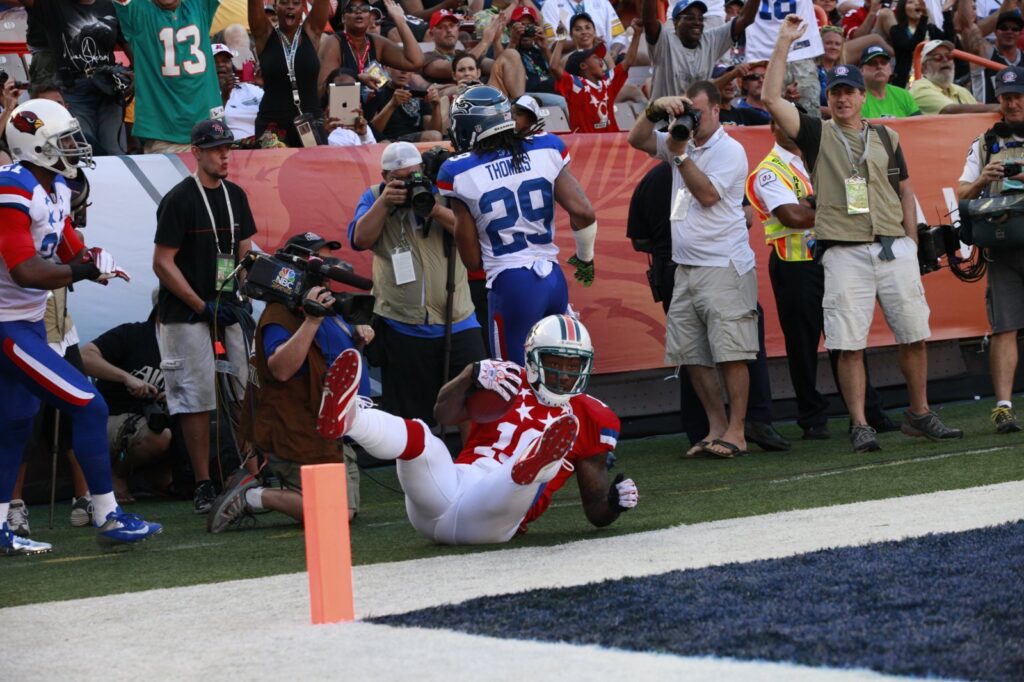
Most football is supposed to hurt. Unnecessary roughness is the part the rulebook says is not necessary: a hit on a runner who is already out of bounds, a late shove after the whistle, a defender diving onto a pile that has already stopped. It costs 15 yards, and when the defense commits it, the offense also gets a first down.
Through Week 6 of the 2026 season, the league’s play-by-play logs 58 unnecessary roughness penalties in 93 games, the sixth most called foul. Defenses committed 48 of them and offenses 10.
What the rule says
Rule 12, Section 2, Article 8 starts with one sentence: “There shall be no unnecessary roughness.” It then lists acts that count, and says the list is not complete. In plain terms, a player may not:
- Strike an opponent with a whipping motion of the leg (a leg whip).
- Forcibly contact a runner after he is out of bounds.
- Block a kicking-team player out of bounds after going out of bounds himself during a kick, as a member of the receiving team.
- Run into, dive into or throw his body on a runner whose forward progress has been stopped, who has slid or taken a knee, or who has gone down untouched and made no attempt to get up and advance.
- Dive into or throw his body on any player on the ground, before or after the ball is dead.
- Throw the runner to the ground after the ball is dead.
- Unnecessarily hit a player who is out of the play, or who should not reasonably expect to be hit.
- Pull an opponent off a pile in an aggressive or forcible way.
- Hit a kicker or punter who is standing still or fading back after the kick, until the play ends or he takes on a defensive role.
The penalty is 15 yards. If the foul is by the defense, it is also an automatic first down. The officials can disqualify the player if they judge the act flagrant.
The same article sits next to the rules on defenseless players, impermissible use of the helmet and roughing the passer. Hits to the head or neck of a defenseless player are called under Article 9, and the play-by-play logs those under the same “unnecessary roughness” label. Our guide to defenseless players and helmet contact covers that part. This guide is about the late and out-of-bounds hits.
The sideline hit
The note under the out-of-bounds rule puts the burden on the defense. Defenders “must make an effort to avoid contact,” and they are responsible for knowing when a runner has crossed the boundary line. The only exception is a doubtful case, such as a runner who steps on the line and keeps running alongside it.
That means a defender chasing a runner toward the sideline has to pull up, or at least ease off, at the line. A tackle that starts in bounds and carries both players out is legal. A shove or a hit that arrives after the runner is clearly out of bounds is the foul.
The out-of-bounds hit is one of the few unnecessary roughness calls that replay can change. Under Rule 15, a foul called only for forcibly contacting a runner out of bounds can be reviewed, and it is wiped off if there is clear and obvious video evidence that the runner was not out of bounds yet.
When is a hit late?
A late hit is about when the ball became dead. Rule 7 says the play is over when a runner is down by contact, when his forward progress is stopped, when he goes out of bounds, or when he gives himself up. A quarterback who slides feet first or head first is down the moment he touches the ground with anything other than his hands or feet. Defenders must treat a sliding runner like one who is down by contact and must pull up when he starts to slide.
The rule also gives defenders some room. If a defender has already committed to the tackle and the contact cannot be avoided, it is not a foul unless he hits the runner in the head or neck area with his helmet, shoulder or forearm, or does something else that is unnecessary roughness. And a runner who waits until the last moment to start his slide puts himself at risk of being hit.
How it is enforced
Most unnecessary roughness fouls happen after the play is over, so the play counts and the 15 yards are added on from where it ended. That can turn a small gain into a big one. Close to the goal line, the half-the-distance rule caps the penalty: no penalty can move the ball more than half the distance to the offending team’s goal line. Twenty of this season’s 58 penalties were for less than 15 yards for that reason.
Three 2026 plays show how much a single flag can change:
- Week 1, Patriots at Seahawks. On third-and-5, Drake Maye scrambled for 1 yard and was pushed out of bounds at the New England 27. Seattle’s Derick Hall was flagged, and instead of fourth-and-4 at their own 27, the Patriots had a first down at the 42. The drive still ended in a punt, and Seattle won 13-10.
- Week 1, Cowboys at Giants. Jaxson Dart ran 22 yards and went out of bounds at the Dallas 37, and DeMarvion Overshown was called for unnecessary roughness. The 15 yards moved the ball to the Dallas 22, and Cam Skattebo scored four plays later in a 28-20 Giants win. Overshown is close to returning from injury this week.
- Week 6, Cowboys at Packers. The offense can commit it too. Trailing 23-7, Dallas converted a fourth-and-5 with an 11-yard catch to the Green Bay 12, but guard Tyler Booker was flagged after the play. The Cowboys kept their first down, but the new series started at the Green Bay 27 instead of the 12, and the drive ended on downs.
2026 by the numbers
| Detail | 2026 through Week 6 | 2025 season |
|---|---|---|
| Unnecessary roughness penalties | 58 in 93 games | 173 in 272 games |
| Per game | 0.62 | 0.64 |
| By the defense / offense | 48 / 10 | 136 / 37 |
| On kickoffs, punts, field goals and tries | 13 | 36 |
| Rank among all penalties | 6th | 6th |
| Most by one team | 6 (Seahawks) | 10 (Cowboys, 49ers) |
Seattle had three in one game, a Week 4 meeting with the Chargers. The rate has barely moved from last season. About one in five unnecessary roughness flags this season came on a kicking play, where blockers and tacklers are running full speed in the open field.
Fines, ejections and the new strike system
A flagrant unnecessary roughness foul can get a player ejected on the spot. For 2026, Rule 19 also lets designated members of the league’s officiating department consult with the officials about disqualifying a player for a flagrant act even when no flag was thrown, as long as it happens before the next snap.
Fines are handled by the league office after the game. The three-strike suspension system the league and the players’ union adopted for 2026 counts only five techniques: hip-drop tackles, horse-collar tackles, launching, hits on defenseless players and blindside blocks. A late hit on a sliding quarterback or a shove out of bounds is not one of them, unless it is also a hit on a defenseless player. Malik Mustapha’s hit on Stefon Diggs shows how that system works.
A Lambeau footnote
Not every personal foul is worth 15 yards. In Brett Favre’s first game back at Lambeau in 2009, Packers defensive lineman Johnny Jolly was flagged for a personal foul on a third-down play that ended at the Green Bay 14. Half the distance to the goal made it a 7-yard penalty and a Minnesota first down at the 7, and Adrian Peterson scored four plays later.
What to watch for
- Watch the sideline. If the runner’s foot is already out when the hit lands, expect a flag. If the tackle started in bounds, there usually is not one.
- Watch the slide. A quarterback who starts sliding early is protected. One who slides at the last moment is not always.
- The yards come on top of the play. Because the play counts, a 20-yard run plus a late hit is a 35-yard gain.
- Defense fouls give a first down. A late hit on third down keeps the drive alive even if the play came up short.
- Near the goal line it is half the distance. Inside the 30, the penalty is usually less than 15 yards.
Related WhyNFL reading: Defenseless players and helmet contact, Roughing the passer, Roughing the kicker, Tripping, striking, kicking and kneeing, Unsportsmanlike conduct, Ejections and suspensions, After the flag.
A rule or explanation needs a second look? Tell us through our corrections process.