Delay of game explained: the play clock, the 5-yard penalty and why teams take it on purpose
Rule 4-6 gives an offense 40 seconds, or 25 after certain stoppages, to snap the ball. Here is the 5-yard penalty, the other acts that count as delay, and why 51 of the 98 delays called through Week 6 of 2026 came on fourth down.
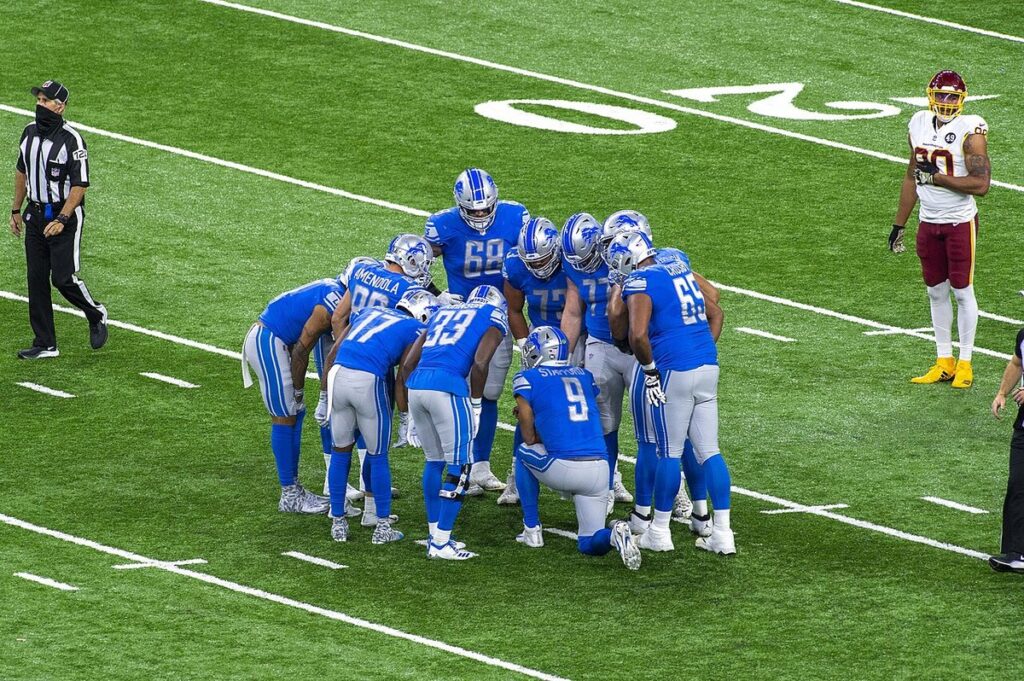
The NFL gives an offense 40 seconds to snap the ball after a play ends, and sometimes only 25. Miss it and the back judge blows his whistle, the ball stays dead and the offense moves back 5 yards. Delay of game is one of the simplest rules in the book. It has also been called a lot more often this season, and more than half of those flags come on fourth down.
Through Week 6 of the 2026 season, the league’s play-by-play logs 98 delay of game penalties in 93 games. Only offensive holding (307), false starts (248) and defensive pass interference (105) have been called more. Last season it was 175 in 272 regular-season games, or 0.64 a game. This season the rate is 1.05 a game.
What the rule says
Rule 4, Section 6 says it is delay of game if the ball is not snapped within 40 seconds after the play clock starts. The 40-second clock normally starts the moment the previous play ends, so the huddle, the play call, the walk to the line and any shifts or motion all have to fit inside it.
After certain stoppages the offense gets 25 seconds instead, starting with the referee’s whistle. The rule lists a change of possession, a charged team timeout, the two-minute warning, the end of a quarter, a penalty enforcement, a free kick after a TV break and some replay stoppages. If the play clock runs out, the back judge blows the whistle and the ball remains dead, so no play happens.
| Situation | Play clock |
|---|---|
| After a normal play | 40 seconds, from the end of the play |
| After a timeout, possession change, two-minute warning, end of a quarter or penalty enforcement | 25 seconds, from the referee’s whistle |
| After a 10-second runoff | 30 seconds |
| Stoppage with fewer than 10 seconds left on the play clock | Reset to 10 seconds, or the exact time left, at the referee’s discretion |
The penalty
- 5 yards, walked off from where the next play would have started. Because the ball was dead, the down is replayed: third-and-3 becomes third-and-8.
- No automatic first down when the defense commits it. Delay of game is on the short list of defensive fouls, along with offside, encroachment and neutral zone infraction, that do not give the offense a new set of downs unless the 5 yards reach the line to gain.
- 15 yards if it becomes unsportsmanlike. Two delay of game penalties in a row during the same down, with the game clock running, is an unsportsmanlike conduct foul under Rule 12-3-1(n), and if it is the offense, the game clock then starts on the snap.
- 15 yards for a team that is not ready to start a half, from the kickoff spot.
It is not only the play clock
Article 5 of the same section lists other things that count as delay of game. The list includes:
- A player staying on top of a dead ball or a runner who is already down.
- A snapper who keeps snapping the ball before the officials have had time to get into position. The first time is only a warning.
- Either team taking too long to come out after a timeout.
- A defender lined up within a yard of the line making sudden movements that are not normal defensive movement, clearly trying to make an offensive player false start. A defender who walks toward the line to time the snap and stops when the snap does not come has not fouled.
- Spiking or throwing the ball in the field of play after the down is over, except after a score.
- Touching the ball or a player on purpose to slow down the officials getting the ball ready.
- Asking for a second timeout in the same dead-ball period, or a timeout after a team has used all of its timeouts. That costs 5 yards, and the timeout is charged.
Two of this season’s flags were logged as defensive delay of game after a play had ended, one on a Broncos defender in Week 2 and one on a 49ers defender in Week 4. The penalty was added onto the end of each play.
Why teams take it on purpose
Most delay of game flags look like mistakes: a slow play call, a late substitution, a crowd too loud to hear the snap count. The Jaguars had three in a Week 5 win over the Eagles in London, two of them after first-and-goal at the 1, and Liam Coen took the blame for them.
But 51 of this season’s 98 delay penalties came on fourth down, and 37 of those were followed directly by a punt. Seven more were followed by a field goal and four by a pass play. Seventeen came on fourth-and-2 or shorter. A lot of those are on purpose. On a short fourth down, an offense can line up as if it is going for it and use a hard count to try to pull the defense offside for a free first down. If nobody jumps, it lets the play clock run out, takes the 5 yards and punts or kicks. Some teams near midfield also back up on purpose to give the punter more room.
Two recent games show the field goal version late in close games. In Week 5, the Broncos led the Chargers 20-17 and faced fourth-and-2 at the Los Angeles 13. The Chargers were out of timeouts. Denver lined up in a run formation, did not snap the ball and took the delay at 1:12. Wil Lutz kicked a 36-yard field goal for a 23-17 lead, and that was the final score.
In Week 6, the Patriots led the Jets by seven and faced fourth-and-1 at the New York 4 after a third-down run snapped at 2:00. The Jets had no timeouts left. New England showed a run formation, the play clock ran out at 1:14, and after the 5-yard penalty Andy Borregales kicked a 27-yard field goal for a 10-point lead. The Patriots won 26-19. Corey Kiner’s eight straight carries to close out the Jets are a story of their own.
In both cases the defense had to stay disciplined against a possible snap, the kick only got 5 yards longer, and the full 40 seconds came off the game clock before the penalty. What a team cannot do is keep doing it. A second straight delay during the same down while the clock is running becomes the 15-yard unsportsmanlike foul.
2026 by the numbers
| Detail | 2026 through Week 6 | 2025 season |
|---|---|---|
| Delay of game penalties | 98 in 93 games | 175 in 272 games |
| Per game | 1.05 | 0.64 |
| On fourth down | 51 | 87 |
| In the fourth quarter | 37 | 61 |
| In the last two minutes of a half | 15 | 35 |
| Rank among all penalties | 4th | 5th |
| Most by one team | 7 (Broncos, Jets) | 11 (Browns, Bengals) |
Week 1 had the most, 22 in 16 games. Buffalo is the only team that has not been flagged for one this season. The share that comes on fourth down has hardly changed, about half in both seasons, so the jump is not only fourth-down strategy. Delays on first, second and third down are up too, from 0.32 a game last season to 0.51.
The most famous spike that wasn’t
Spiking the ball to stop the clock is legal. Spiking it after the play is over is delay of game. And pretending to spike is not a foul at all. On October 27, 2013, the Lions had no timeouts when Calvin Johnson was tackled at the Dallas 1 on a play that started with 33 seconds left. Matthew Stafford ran to the line shouting for a spike, took the snap with 14 seconds left and jumped over the pile for the winning touchdown. Our story on that game has Johnson’s 329-yard day catch by catch.
What to watch for
- Watch the play clock, not the game clock. Under 5 seconds with the quarterback still calling signals usually means a timeout or a flag is coming.
- Which number started? After a timeout or penalty, the offense has 25 seconds from the whistle, not 40.
- Fourth-and-short with a punter or kicker on the sideline often means a hard count first. If nobody jumps, expect a delay and a kick.
- The down does not change. It is a dead-ball foul, so the same down is replayed 5 yards back.
- Two in a row costs 15. A second straight delay on the same down while the clock is running is unsportsmanlike conduct.
Related WhyNFL reading: Two clocks, one possession: NFL timing explained, False start, encroachment, neutral zone infraction and offside, Illegal substitution and 12 men on the field, Unsportsmanlike conduct, After the flag, NFL penalties after Week 5.
A rule or explanation needs a second look? Tell us through our corrections process.