Kneel-down and victory formation explained: when the ball is dead, the 40-second math and the fumble that changed it
Rule 7-2-1(c) makes the ball dead the instant a quarterback drops to a knee. Here is how the victory formation came out of the 1978 Miracle at the Meadowlands, how many seconds each kneel burns, and what defenders can and cannot do.
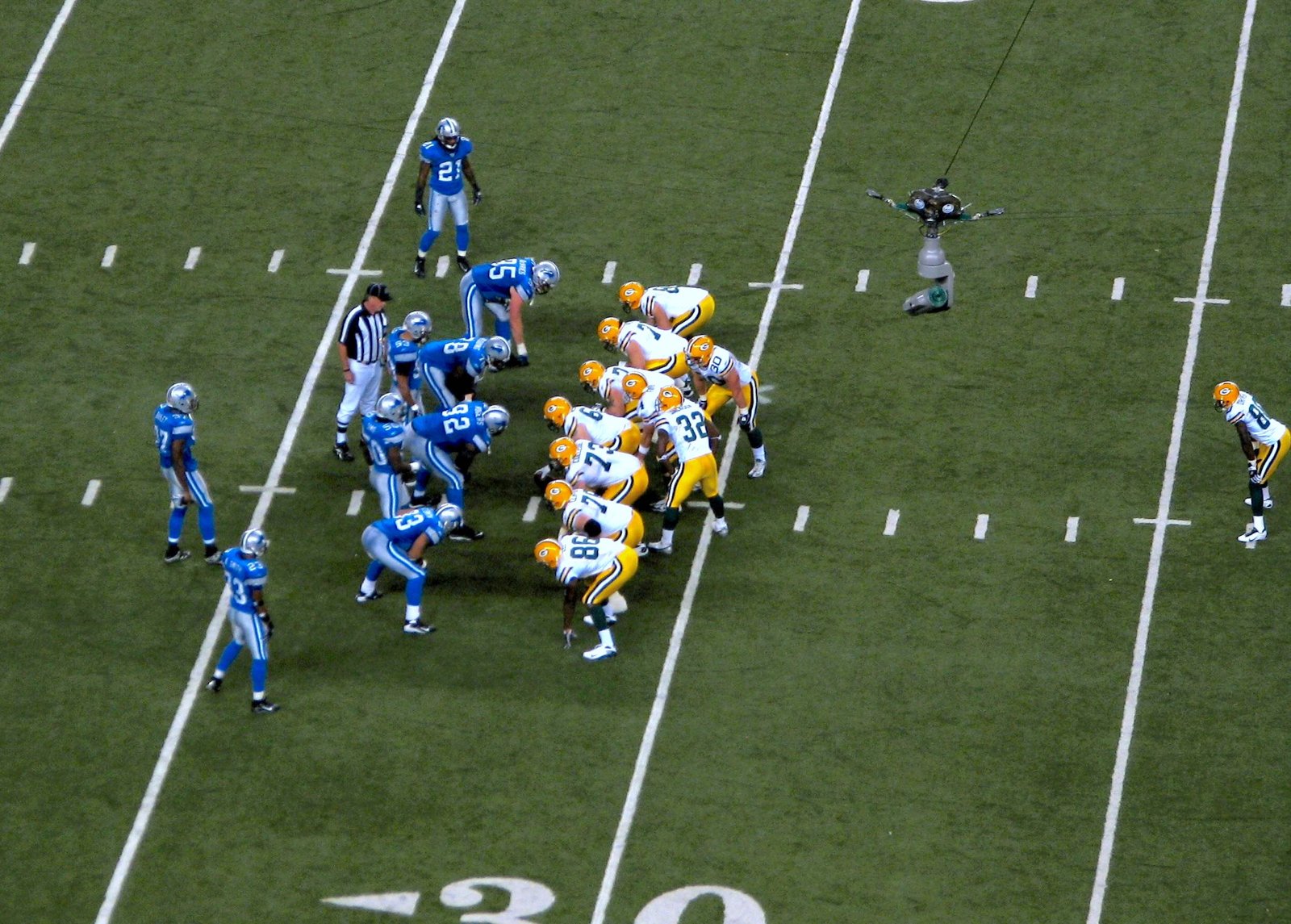
The kneel-down is the least exciting play in football and one of the most common. Through the first 94 games of 2026, quarterbacks have taken a knee 145 times, and 64 of those games ended on one. Here is what the rulebook says about it, why teams line up the way they do, and how the clock math works.
What the rule says
Rule 7-2-1(c) says the ball is dead “when a quarterback immediately drops to his knee, or simulates dropping to his knee, behind or beyond the line of scrimmage.” The play is over the moment the knee goes down, or the moment he starts to fake it. He does not have to be touched.
That second part means a fake kneel-down is not a trick play. If the quarterback starts to go down and then pops up and throws, officials have already blown the play dead.
Defenders are protected, too. A note to the same rule says that if the quarterback does not immediately drop to a knee and contact from a rushing defender is unavoidable, it is not a foul unless the defender does something else that would be unnecessary roughness. Once a player has taken a knee, Rule 12-2-8(d) makes it unnecessary roughness to run, dive or throw the body into him. That is a 15-yard penalty.
Why the victory formation looks the way it does
The formation was born from a disaster. On November 19, 1978, the New York Giants led the Philadelphia Eagles 17-12 in the final minute, and the Eagles were out of timeouts. Instead of having Joe Pisarcik fall on the ball, the Giants called a handoff to fullback Larry Csonka. Pisarcik lost the ball on the exchange, and Eagles cornerback Herman Edwards picked it up on the bounce and ran 26 yards for the winning touchdown. The Eagles won 19-17, and the Giants fired offensive coordinator Bob Gibson the next day.
Teams soon began protecting the kneel-down with what is now called the victory formation: blockers packed tight around the quarterback and a safety-valve player lined up several yards behind him to tackle anyone who picks up a loose ball. The quarterback’s only job is to take the snap and go down.
It has worked. The official play-by-play shows more than 3,400 kneel-downs in the regular season from 2018 through Week 7 of 2026, and not one fumble on any of them.
| Season | Kneel-downs | Games ending on a kneel-down | Total yards |
|---|---|---|---|
| 2018 | 395 | 153 of 256 | -413 |
| 2019 | 398 | 164 of 256 | -414 |
| 2020 | 419 | 167 of 256 | -443 |
| 2021 | 396 | 152 of 272 | -426 |
| 2022 | 424 | 164 of 271 | -448 |
| 2023 | 429 | 162 of 272 | -474 |
| 2024 | 405 | 158 of 272 | -457 |
| 2025 | 434 | 164 of 272 | -459 |
| 2026 through 94 games | 145 | 64 of 94 | -172 |
The clock math
A kneel-down ends with the ball dead in the field of play, so the game clock keeps running. The offense then has 40 seconds on the play clock to snap the ball again. If the defense has no timeouts, each kneel-down uses about 41 seconds: the full play clock plus a second for the play itself.
The two-minute warning matters here. It is an automatic timeout after the last play that starts before two minutes remain in the half. After it, a team with a first down can kneel three times and run off the final two minutes. That is why the end of a game so often looks like this one from Week 5 this season:
- Minnesota led New Orleans 23-13 and had a first down at the Saints’ 38 after the two-minute warning. The Saints had used all three timeouts.
- After the two-minute warning, Kyler Murray knelt at 2:00, again at 1:19 and again at 0:38.
- The play clock ran out the last 38 seconds, and the game ended without a fourth snap.
Every timeout the defense still has takes away roughly 40 seconds of that math. A team can also kneel on fourth down when the lead is safe. In Week 1, Kansas City led Denver 31-10 and knelt on second, third and fourth down after the two-minute warning. Denver got the ball back at its own 18 with 36 seconds left, and Bo Nix took a knee as well.
Going down short of the goal line
The same idea explains why a runner sometimes stops before he scores. On December 16, 2007, Philadelphia led Dallas 10-6 with just over two minutes left when Brian Westbrook broke into the open. He went down at the 1-yard line instead, and the Eagles knelt out the win. Right tackle Jon Runyan had told him to do it. “They were going to let us score to get the ball back, so I suggested this because then they won’t get it back,” Runyan said.
A runner who goes down on his own like that has declared himself down under Rule 7-2-1(d), and the ball is dead where he goes to the ground. One place this does not work is behind your own goal line. A kneel in your own end zone is a safety, because the ball is dead there and the offense supplied the impetus.
Should the defense rush it?
Most defenses do not try very hard against a kneel-down, but nothing requires them to stand still at the snap. On September 16, 2012, Tampa Bay’s defense charged into the Giants’ line on Eli Manning’s final kneel-down of a 41-34 New York win. Manning was knocked down, and Tom Coughlin confronted Bucs coach Greg Schiano after the game. Schiano said his team plays until the game is over and that the play was not dirty or illegal.
The rule still draws the line at the quarterback. Defenders can fire off the ball and try to knock the center back into him. But once his knee is down, the ball is dead, and hitting him is a personal foul.
What to watch for
- Count the timeouts. If the trailing team has none and the leader has a first down after the two-minute warning, the game is effectively over.
- Watch the deep player. The player lined up well behind the quarterback is there in case the snap goes loose.
- Fourth-down kneels. A leading team will sometimes kneel on fourth down and give the ball back with a handful of seconds left rather than punt.
- End of the first half. About one in five kneel-downs come before halftime, when a team would rather not risk a turnover deep in its own territory.
- Runners stopping short. Late in close games, a runner may go down at the 1 so his team can kneel out the clock.
Related WhyNFL reading: Timeouts, Delay of game and the play clock, Fumble rules, Unnecessary roughness and Safety vs. touchback.
A rule or explanation needs a second look? Tell us through our corrections process.