Illegal wedge and double-team blocks on kickoffs explained
What Rule 6-2-1 bans as an illegal wedge or illegal double-team on the 2026 kickoff, why contact is not required for a wedge flag, who may double-team from the setup zone, and why WED and IDT are still on the books even with zero accepted flags through Week 5.
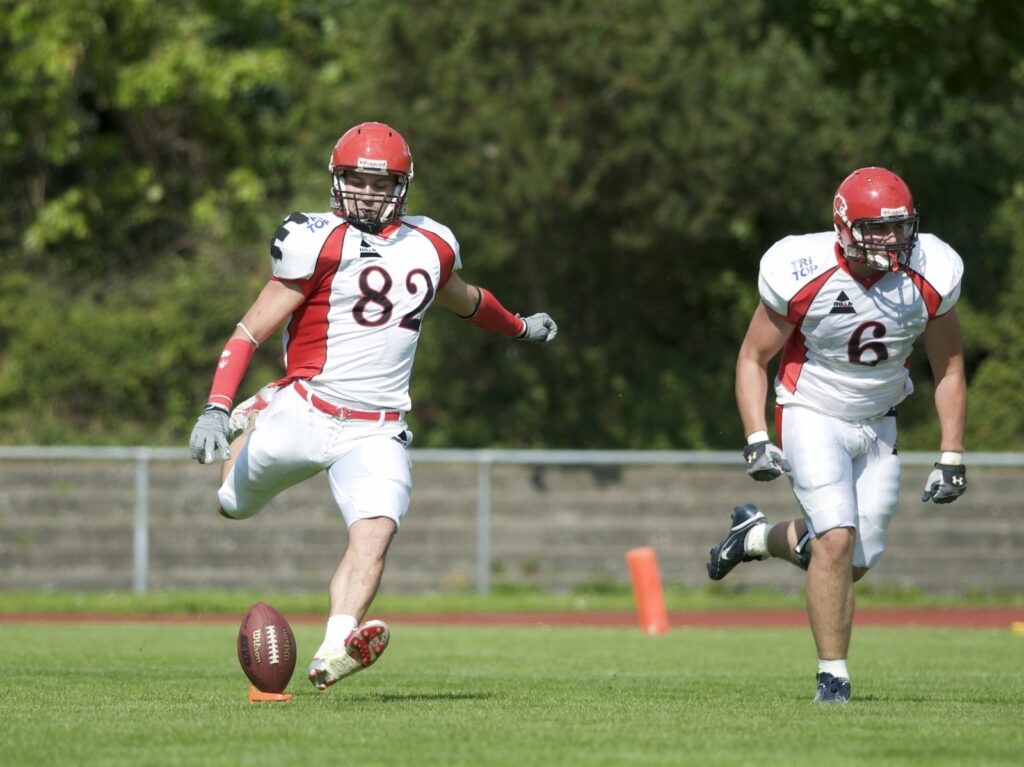
On a modern kickoff, the biggest collision risk is not always the returner. It is two or three blockers locking together and rolling forward as a wall. The 2026 Official Playing Rules still ban that wall. Rule 6, Section 2, Article 1 makes an illegal wedge block a foul the moment two or more players intentionally line up shoulder-to-shoulder within two yards and move forward together — contact is not required.
A related foul, the illegal double-team block, limits who may hit the same coverage player at the same time. Only receivers who started the play in the setup zone may double-team. Everyone else is restricted. Both fouls cost 15 yards. On the referee’s sheet they code as WED (illegal wedge) and IDT (illegal double team).
This guide is about those blocking fouls under the 2026 kickoff. For where the ball lands and how touchbacks are spotted, see our separate landing-zone and touchback guide.
What counts as a wedge
Rule 6-2-1 Item 2(d) defines a wedge block as two or more players who:
- intentionally align shoulder-to-shoulder
- within two yards of each other
- and move forward together
The foul is complete at that point. Officials do not have to wait for the wall to hit a coverage player. Any players can commit it — there is no setup-zone exception for a wedge. The rulebook says a wedge “is not permitted by any players at any time” on a kickoff or safety kick.
Double-team blocks: who may, who may not
A double-team block is different. Rule 6-2-1 Item 2(c) defines it as two or more players who contact an opponent at the same time. That is legal only for players who were lined up in the setup zone when the ball was kicked. Players who started elsewhere — including returners deeper in the landing zone — may not join a double team at any point during the kick or the return.
So the setup-zone blockers can pair up on a coverage player. A returner peeling back to help, or two players who started outside the zone, cannot.
The 15-yard enforcement
Illegal wedge and illegal double team share one penalty paragraph:
| When the foul happens | Where the 15 yards come from |
|---|---|
| During the kick (before the receiving team establishes possession) | Spot of the foul |
| During the return (after possession) | Customary three-and-one / dead-ball enforcement |
| In the receiving team’s end zone during the kick, or on an onside kick | Previous spot |
Ordinary illegal blocking or illegal use of hands on the kickoff is a separate 10-yard foul under the same article. Wedge and double-team are the 15-yard versions aimed at organized walls.
Rule 14 also lists illegal wedge and illegal double team among the free-kick fouls that stay at the spot of the foul (or the previous spot in the end zone / onside cases) instead of always sliding to the end of the kick.
Other kickoff blocking limits that sit next to the wedge
Even without a wedge, receiving-team blockers are on a short leash until the ball arrives:
- No initiating a block against the kicking team until the ball hits or is touched in the landing zone or end zone.
- Once the kick is live for blocking, receivers follow the offensive blocking restrictions in Rule 12, Section 1.
- Onside kicks keep the same wedge and double-team bans, with their own zone-by-zone hand-use limits for the kicking team.
Those timing rules are why kickoff returns no longer feature the old full-field sprint into a three-man wall. Alignment and movement are compressed; the wedge ban removes the last legal way to rebuild that wall on the fly.
2026 so far: rare flags, still live rules
Through Week 5 of 2026 (79 games), public play-by-play logs show zero accepted Illegal Wedge fouls and zero accepted Illegal Double Team fouls. Kickoff fouls that did show up were mostly placement and alignment: 13 kicks short of the landing zone and 8 kickoffs out of bounds.
Zero accepted flags does not mean the rules are gone. Officials still watch for two players locking shoulder-to-shoulder and surging forward, and for a non-setup-zone player joining a double team. The empty column is a sign the alignment has worked — not that WED and IDT were deleted.
Where the wedge ban came from
Multi-player wedges were a staple of kickoff returns for decades. Safety concerns around high-speed collisions led the league to restrict and then eliminate them. By 2018, owners had already banned the wedge on kickoffs and limited double-team blocks to players in a setup zone as part of a broader kickoff rewrite. The 2024–26 “dynamic” kickoff kept those bans while changing where everyone lines up and how touchbacks are spotted.
The codes remain on the 2026 foul list: WED for illegal wedge, IDT for illegal double team. They sit in the same Rule 6 family as the landing-zone placement rules covered in our kickoff guide.
Watch: the dynamic kickoff frame
The league’s video rulebook walkthrough shows the modern alignment — kicker at the 35, coverage players at the receiving 40, setup zone and landing zone — which is the stage on which the wedge and double-team bans still apply.
What to watch on the next kickoff
- Shoulder-to-shoulder and moving forward? That is a wedge even before anyone is hit (WED, 15 yards).
- Two players hitting the same coverage man? Legal only if both started in the setup zone (otherwise IDT, 15 yards).
- Block before the ball arrives? Receiving team cannot initiate contact until the ball hits or is touched in the landing zone or end zone.
- Onside look? Same wedge and double-team bans, with tighter hand-use rules between the restraining lines.
- Separate from leaping? Leaping and leverage on field goals are Rule 12-3-1 fouls — see that guide — not these kickoff codes.
Related WhyNFL reading: The 2026 kickoff: landing zone and touchbacks, Leaping and leverage on kicks, Block in the back, clipping and illegal block below the waist, Illegal bat and illegal kick, After the flag, 2026 penalties by the numbers, October 23, 2016: the 6-6 Seahawks–Cardinals tie.
A rule or explanation needs a second look? Tell us through our corrections process.