Forward progress and down by contact explained: when an NFL play is over and where the ball is spotted
A runner who falls untouched can get up and keep going, but one held upright in a pile can be ruled down. Here is how Rules 7-2-1 and 3-12-1 define down by contact, giving yourself up, slides and forward progress, and how replay treats them.
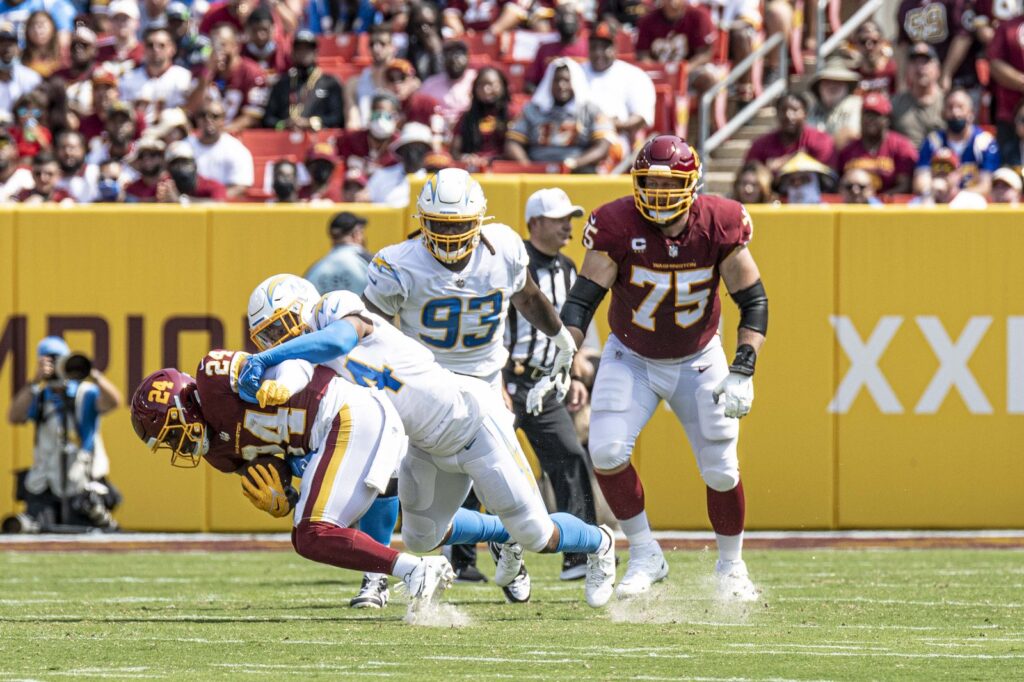
An NFL play does not end just because a runner hits the ground. A ball carrier who slips without being touched can get up and keep running, while a runner held upright in a pile can be ruled down even though no knee touched the turf. Two ideas decide when the whistle should blow and where the ball is spotted: down by contact and forward progress. Both come up almost every Sunday, on goal-line piles, fourth-down measurements and replay reviews of fumbles.
Down by contact: touched, then on the ground
Rule 7-2-1(a) ends the play once an opponent has made contact with the ball carrier and the ball carrier then hits the turf with something besides a hand or a foot. The 2026 rulebook spells out that the wrist counts as part of the hand and the ankle as part of the foot. So a runner who is touched and then puts a hand down to keep his balance is still alive. One who is touched and then lands on a knee, a hip, an elbow or his backside is down.
Both parts are needed. The contact does not have to be a tackle; a defender’s hand brushing the runner’s leg is enough, and the runner can go down a moment later. Without any touch from an opponent, though, a runner who falls has not been downed.
Falling untouched: get up and run
This is where the NFL differs from college and high school football, where a runner is down as soon as a knee touches the ground whether anyone touched him or not. In the NFL, a back who trips over his own lineman’s foot can bounce up and keep going, and defenders have to finish the play by touching him.
There are limits. Under Rule 7-2-1(d), a runner who falls or kneels and clearly makes no immediate effort to advance has declared himself down. So has a runner who slides or dives, feet first or head first: the play ends the instant any body part but a hand or foot meets the turf. Rule 7-2-1(c) adds the quarterback kneel, which ends the play as soon as he goes down to a knee, or pretends to. And under 7-2-1(f), if a defender touches the ball while the runner is lying on the ground, the play is over.
Forward progress: where the ball goes
Rule 3-12-1 defines forward progress as the point where a runner’s advance toward the opponent’s goal ends. That is where the ball is spotted, even if the defense then pushes or carries him backward. A running back who reaches the 32-yard line and is driven back to the 29 by three tacklers gets the 32.
Forward progress can also end the play by itself. Rule 7-2-1(b) kills the play when defenders hold the ball carrier, or otherwise keep him from going any farther. That is why officials blow the whistle on a stalled pile even with the runner still on his feet. The same idea covers airborne receivers: if a defender drives a receiver backward before he lands, he gets credit for the spot where he was first hit after securing the ball.
Quarterbacks get extra protection. The rulebook tells officials to blow the play dead once a tackler clearly has hold of a passer behind the line and the quarterback’s safety is at risk.
| Situation | Is the ball dead? | Rule |
|---|---|---|
| Touched by a defender, then knee or elbow hits the ground | Yes, down by contact | 7-2-1(a) |
| Touched, then only a hand or wrist hits the ground | No, play goes on | 7-2-1(a) |
| Trips and falls with no defender touching him | No, he can get up and advance | 7-2-1(a), 7-2-1(d) |
| Falls untouched and makes no effort to get up | Yes, he has given himself up | 7-2-1(d)(1) |
| Slides feet first or dives | Yes, when he touches the ground with anything but hands or feet | 7-2-1(d)(2) |
| Held upright in a pile and no longer moving forward | Yes, forward progress stopped | 7-2-1(b) |
| Defender touches the ball while the runner is on the ground | Yes | 7-2-1(f) |
Why it matters for fumbles and replay
The two rules decide many fumbles. If the ball comes out after the runner’s knee was down, there is no fumble. If it comes out first, it is a live ball. Replay can look at whether the officials missed a down-by-contact call, and whether a runner lost the ball before he was down, before he went out of bounds, or before or at the same time as the contact that stopped his forward progress. When officials have blown the play dead too early, replay can still award the ball to a player who clearly recovered it in the immediate action that followed. That is why officials often let a close play run on: a fumble can be taken away in review, but a whistle cannot be undone. Our guides to fumble rules and challenges and replay cover the rest.
For measurements near the line to gain, replay can review whether the ball was spotted before the line, on it or past it. For that review, forward progress is the point where a player in control of the ball was contacted by an opponent and driven backward. A challenge on a spot succeeds only if it changes whether the offense got a first down, not just because the ball moves a few inches.
Defenders must stop too
Once a runner is down, the defense has to pull up. Piling onto a stopped runner, a sliding or kneeling one, or one who went down untouched and stayed there, is unnecessary roughness, a 15-yard foul. The rulebook gives some leeway on slides: if a defender had already committed and the contact could not be avoided, it is not a foul unless he hits the runner’s head or neck with his helmet, shoulder or forearm. A runner who waits until the last moment to start his slide puts himself at risk.
A rule or explanation needs a second look? Tell us through our corrections process.