
Cam Little arrives in Baltimore this week just over a year after his 68-yard field goal against Las Vegas on November 2, 2025. That kick expanded what an NFL offense could consider at the edge of scoring range. It did not make a long attempt a free chance at three points.
Before Jacksonville visits Baltimore at 3:15 am Friday, November 6, Cairo time, there is a useful distinction to watch: a kicker can have the leg to reach the posts without the attempt being the right decision. The hidden cost is where the other offense starts after a miss. That cost also changes dramatically between a kick at halftime and one with several minutes still to play.
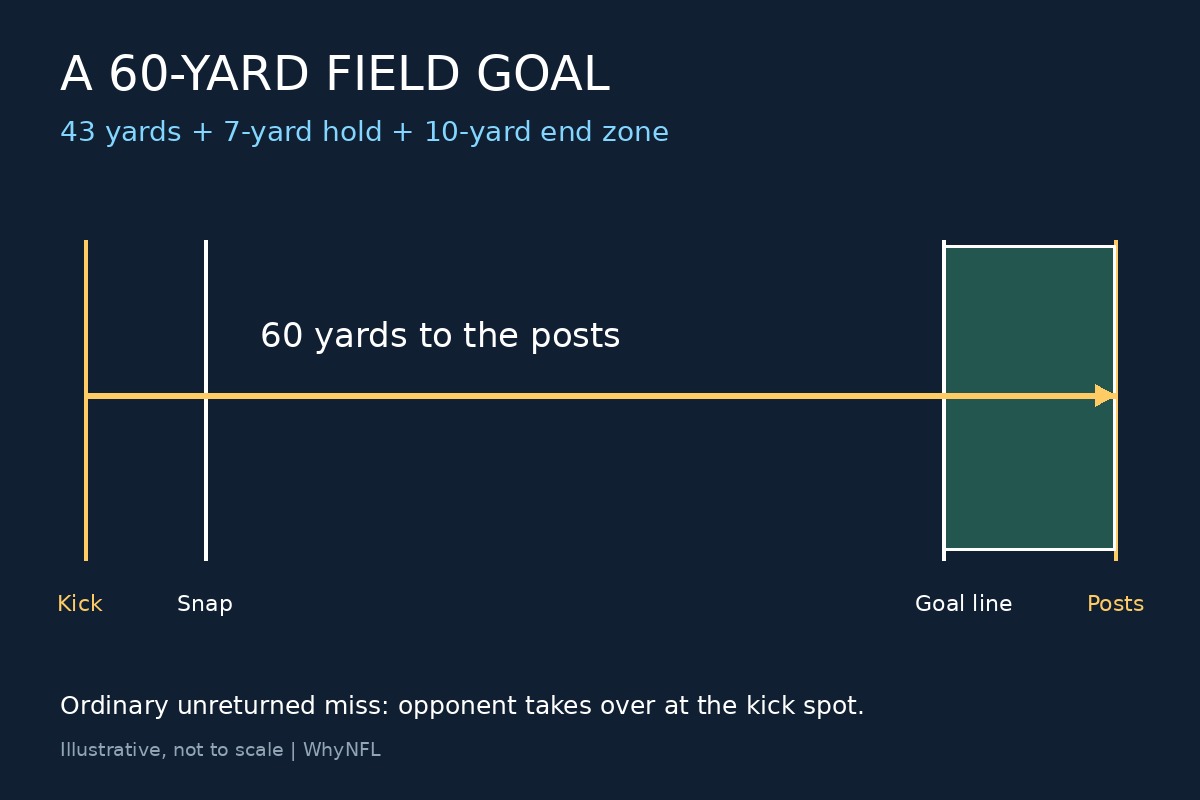
Why the 43-yard line usually means a 60-yard attempt
A field-goal distance is measured to the posts, not just to the goal line. The posts sit at the back of the 10-yard end zone. Add the distance from the line of scrimmage to the holder, commonly about seven yards, and an attempt from the opponent’s 43 becomes roughly 60 yards: 43 + 7 + 10. The hold depth is a setup choice, not a rule requiring every kick to add exactly 17 yards.
That is why “they only need to reach the 40” is an incomplete description of field-goal range. From the opponent’s 40, the same setup produces a 57-yard attempt. Five yards of offensive progress can turn that into 52; a sack can move it in the other direction. Range is a moving target, not a painted line that guarantees points.
A miss normally gives up the kick spot, not the snap spot
Under Rule 11, Section 4, Article 2, an ordinary missed attempt that crosses the line of scrimmage and is not touched by the receiving team beyond that line gives the receiving team the ball at the spot of the kick, or at its own 20 if the kick spot was inside its 20. The distinction matters: on a conventional attempt, the kick spot is several yards behind the snap.
| Attempt distance | Snap location | Opponent starts after an ordinary unreturned miss |
|---|---|---|
| 50 yards | Opponent’s 33 | Receiving team’s own 40 |
| 60 yards | Opponent’s 43 | Midfield |
| 65 yards | Opponent’s 48 | Kicking team’s 45 |
A missed 60-yarder, in other words, can hand the opponent the ball at midfield rather than pinning it deep. For the 65-yard example, the receiving offense already starts in the other team’s half. A punt or a fourth-down play has its own risks, but the choice is not simply three possible points versus zero. It is three possible points versus a different next possession.
Why Little’s record kick was a different kind of decision
Little’s 68-yarder came as the first half expired. The timing removed the usual opportunity for Las Vegas to take the favorable field position after an ordinary dead-ball miss and run its offense before halftime. That does not eliminate every danger: a kick can be blocked, and a short kick that remains live can be returned. It does change the balance of the decision.
The useful lesson is about game state, not a claim that every kicker should try from that distance. With time remaining, a coach has to weigh the likely next possession. As a half expires, that part of the cost can disappear. A desperation attempt at the end of a game is different again: a team that must score immediately may have no value left to protect by punting.
What to watch in Jaguars-Ravens
Do not assume the game is a direct long-range duel between Little and Tyler Loop. Baltimore announced that Jake Moody would handle the kicking against Jacksonville after Loop’s right-groin injury. That personnel change is another reason not to transfer one kicker’s longest make to a team-wide promise of range.
Watch the actual kick spot, the time left and the alternative. A strong warmup kick is evidence of distance, not a measured in-game make probability. Wind, footing, snap, hold and the rush all belong in the decision; this feature is not assigning a percentage to a particular attempt or forecasting the weather in Baltimore.
For the broader decision, see our fourth-down guide. The practical question tonight is narrower: if the kick misses, where does the opponent get the ball, and will there be time to use it? Little’s record shows what is possible. The rulebook explains why possible is not always preferable.
No published comments yet. Start the conversation.