Illegal forward pass, illegal touching and ineligible man downfield explained
One forward pass per down, from behind the line. Here is how the 2026 rules handle a pass from beyond the line, a second forward pass, a lineman touching the ball first, a receiver coming back from out of bounds and an offensive lineman too far downfield, plus what replay can and cannot review.
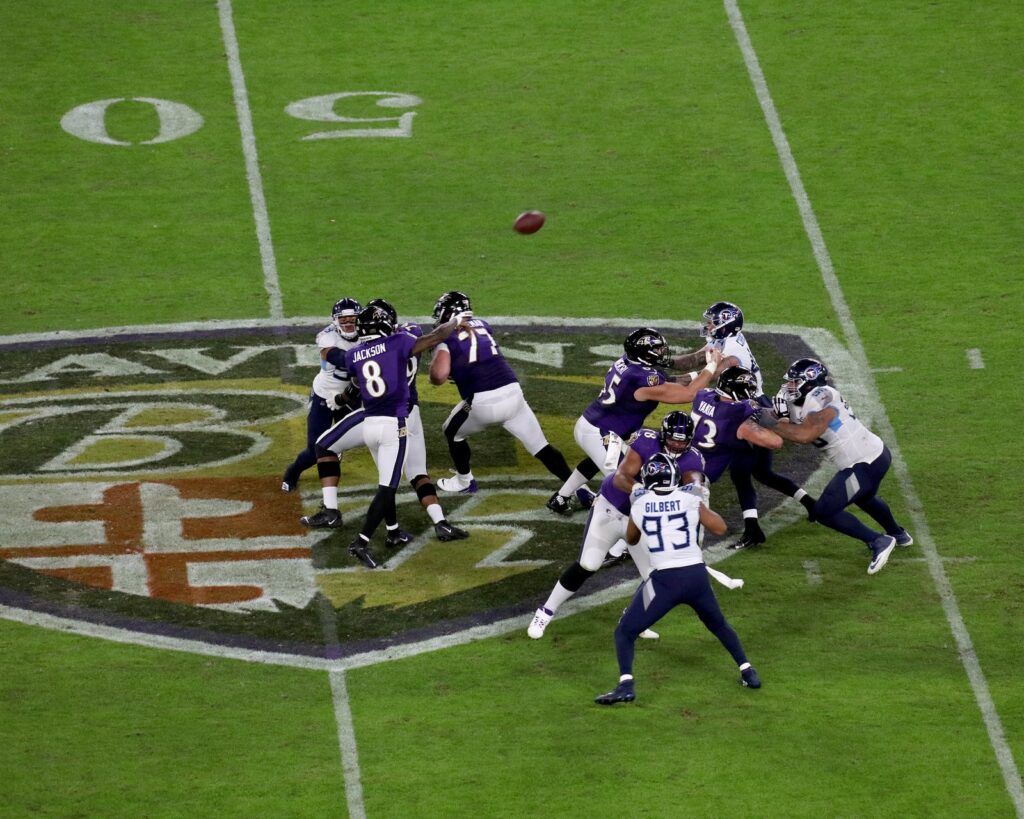
The offense gets one forward pass per down, and it has to come from behind the line of scrimmage. Three fouls police that idea. An illegal forward pass is a pass thrown from the wrong place or at the wrong time. Illegal touching is the wrong player touching the pass first. Ineligible man downfield is an offensive lineman too far past the line before the ball is thrown. Some versions also cost the offense a down.
All three are rare. Through Week 5 of the 2026 season, public penalty logs show one accepted illegal forward pass (Trevor Lawrence in the Jaguars’ Week 1 home game against Cleveland) and one illegal touching foul (Miami receiver Chris Bell at Minnesota in Week 4). Ineligible downfield has been flagged 16 times, with 12 accepted, and every one was called on an offensive lineman. Baltimore leads the league with three.
The rule: one forward pass, from behind the line
Rule 8, Section 1, Article 2 of the 2026 Official Playing Rules says the offense may make one forward pass from behind the line on each down. Once the ball crosses the line, in a runner’s hands or loose, a forward pass is no longer allowed, even if the ball comes back behind the line before it is thrown. A pass is forward if the ball first moves toward the opponent’s goal line, or first lands nearer to it than the spot where it left the passer’s hand. Our catch-rule guide covers what happens after it is thrown.
Backward passes are a different matter. A runner can pitch or lateral backward at any time, so trick plays that start with a toss or reverse and end with a throw downfield are legal. The only condition is that the throw has to be the down’s only forward pass, made from behind the line.
Four ways a pass becomes illegal
The rule lists four illegal forward passes, and each one is a foul by the passing team:
- Thrown from beyond the line. It is a foul only if the passer’s entire body and the ball are past the line when he releases it, whether he is on the ground or in the air. One foot over is not enough.
- A second forward pass from behind the line. For example, a pass completed behind the line that is then thrown forward again.
- Thrown after the ball crossed the line and came back. A runner who gets past the line and retreats cannot then throw forward.
- Thrown after a change of possession. A defender who intercepts a pass or recovers a fumble cannot throw it forward.
If an illegal pass is caught or intercepted, the ball stays alive and can be advanced. The other team can then decline the penalty and keep the result of the play.
Penalties at a glance
| Foul | Rule | Penalty | Enforced from |
|---|---|---|---|
| Forward pass from beyond the line | 8-1-2 | Loss of down and 5 yards | Spot of the pass |
| Second forward pass, or pass after the ball came back behind the line | 8-1-2 | Loss of down and 5 yards | Previous spot |
| Forward pass after a change of possession | 8-1-2 | 5 yards | Spot of the pass |
| Illegal touching by an ineligible player | 8-1-8(a) | 5 yards | Previous spot |
| Illegal touching after going out of bounds | 8-1-8(b) | Loss of down | Previous spot |
| Ineligible man downfield | 8-3-1 | 5 yards | Previous spot |
Loss of down means the down counts even though the offense gains nothing. An illegal forward pass is one of the league’s combination penalties, so the offense loses the down and the yards together. On fourth down the ball goes to the other team, and the five yards are still marked off. A second pass thrown from inside the passer’s own end zone gives the defense the option of a safety.
Passes from beyond the line follow different rules
A pass from beyond the line is treated as a foul during a running play. That changes several things:
- Anyone can catch it. Eligibility, pass interference and intentional grounding rules do not apply.
- No roughing the passer. That protection covers passes thrown from behind the line, legal or not. A late hit on a quarterback who threw from past the line can still be unnecessary roughness.
- Passes from behind the line keep their protections. On a second pass from behind the line, eligibility, interference, grounding and roughing rules all still apply, even though the pass is illegal.
Late in a half there is one more cost. After the two-minute warning, an illegal forward pass is one of the actions that cannot be used to stop the clock. If time was running, officials take 10 seconds off the clock unless the offense uses a timeout instead. See our clock guide for how runoffs work.
Illegal touching of a forward pass
Rule 8-1-8 has two versions, with different penalties:
- An ineligible player touches it first. If an originally ineligible offensive player, usually a lineman, intentionally touches or catches a pass thrown from behind the line before anyone else touches it, the penalty is 5 yards from the previous spot. If he catches it, the ball is alive.
- A receiver who went out of bounds touches it first. If an eligible receiver steps out, whether on his own or because he was legally pushed out, comes back in and is the first to touch the pass, the penalty is loss of down at the previous spot.
There are three exceptions to know. A receiver forced out by a defender’s foul stays eligible if he comes straight back in. A receiver who touches the ball while still out of bounds just makes the pass incomplete, with no foul. Once a defender or an eligible offensive player touches the pass, every offensive player becomes eligible, which is why a tipped ball caught by a guard can stand. Linemen who report as eligible to the referee, as on tackle-eligible plays, are covered in our eligible receivers guide.
Ineligible man downfield
On a play with a legal forward pass, it is a foul if an ineligible offensive player has his entire body more than one yard past the line before the pass is thrown. The T-formation quarterback counts as ineligible for this rule. The penalty is 5 yards from the previous spot, with no loss of down.
A lineman is not illegally downfield if he makes contact with a defender within a yard of the line on his first charge and then:
- is carried more than a yard downfield while still blocking or being blocked;
- loses contact past the yard and then stays put, moves sideways or backs up until the pass is thrown; or
- is pushed back behind the line by a defender, after which the normal restrictions apply to him again.
He is illegally downfield if he releases without contacting anyone, keeps moving forward after losing contact, or drifts past the yard after his block ends near the line. Run-pass options put linemen in exactly this spot: they block as if it is a run, and if the quarterback throws instead, any lineman more than a yard downfield without a block is a foul. Once the ball is thrown, linemen can go downfield, but they still cannot block a defender more than a yard past the line until the pass is touched. If that happens near where the ball is thrown, it is offensive pass interference.
What replay can review
Rule 15 makes these passing questions reviewable: whether a pass was forward or backward; whether a forward pass was thrown from beyond the line, or after the ball crossed the line and came back; whether a pass was illegally thrown; whether a receiver touched out of bounds, which decides whether he was still eligible; and whether the passer stepped out of bounds before throwing. Whether an ineligible player was downfield is specifically not reviewable. That stays with the officials on the field.
Watch the rules
The league’s video rulebook explains what counts as a legal forward pass and who can catch one.
What to watch on the next flag
- Where was the passer at release? His whole body and the ball both have to be past the line for an illegal pass.
- Had the ball already crossed the line? Then no forward pass is allowed on that down, even from behind the line.
- Was this the second forward pass? A lateral and then a pass is fine. Two forward passes is not.
- Who touched it first? A lineman touching it first costs 5 yards. A receiver who came back from out of bounds costs the down.
- Where were the linemen at the throw? More than a yard downfield without a block means 5 yards, and replay cannot overturn the call.
- Fourth down or the final two minutes? Loss of down can turn the ball over, and an illegal pass can bring a 10-second runoff.
Related WhyNFL reading: Intentional grounding, Pass interference, Formations and eligible receivers, Roughing the passer, Coach’s challenges and replay, After the flag.
A rule or explanation needs a second look? Tell us through our corrections process.